Understanding Link-State Routing Protocols and Their Mechanisms
This chapter provides a comprehensive overview of link-state routing protocols, including Open Shortest Path First (OSPF) and Intermediate System-to-Intermediate System (IS-IS). It delves into the fundamental concepts of link-state packets, adjacency formation among routers, and the steps involved in the link-state routing process, culminating in the creation of a routing table using Dijkstra’s shortest path first (SPF) algorithm. Key advantages, memory and processing requirements, as well as methods for ensuring efficient bandwidth utilization during convergence, are also discussed.

Understanding Link-State Routing Protocols and Their Mechanisms
E N D
Presentation Transcript
Link-State Routing Protocols Routing Protocols and Concepts – Chapter 10
Introduction • Link-State Routing Introduction • Link-State Packets • Steps
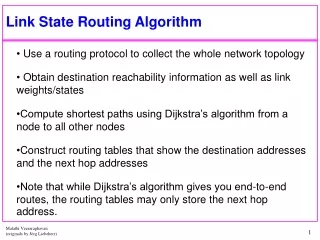
Link-State Routing Introduction • Link state routing protocols • Also known as shortest path first algorithms • These protocols built around Dijkstra’s SPF
Link-State Routing Introduction • 2 link state routing protocols used for routing IP • Open Shortest Path First (OSPF) • Intermediate System-Intermediate System (IS-IS)
Link-State Routing Introduction • Link • An interface on the router • Link State • Information about an interface such as • IP address • Subnet mask • Type of network • Cost associated with link • Neighboring routers on the link
Link-State Introduction • Advantages of a Link-State Routing Protocol
Link-State Introduction • Requirements for using a link state routing protocol • Memory requirements • Typically link state routing protocols use more memory • Processing Requirements • More CPU processing is required of link state routing protocols • Bandwidth Requirements • Initial startup of link state routing protocols can consume lots of bandwidth
Link-State Packets • Sending Hello Packets to Neighbors • Connected interfaces that are using the same link state routing protocols will exchange hello packets • Once routers learn it has neighbors they form an adjacency • 2 adjacent neighbors will exchange hello packets • These packets will serve as a keep alive function
Link-State Packets • LSPs are sent out under the following conditions: • Initial router start up or routing process • When there is a change in topology
Steps • Dikjstra’s algorithm also known as the shortest path first (SPF) algorithm
Steps - Link-State Routing • Link-State Routing Process • How routers using Link State Routing Protocols reach convergence • Step 1 - Learns of directly connected links • Step 2 – Says Hello • Step 3 – Creates LSP • Step 4 – Tells it’s neighbors • Step 5a – Created it’s database • Step 5b – Creates SPF Tree
Step 1 – Discovering it’s links • Directly Connected Networks • Link • This is an interface on a router • Link state • This is the information about the state of the links
Step 2 – Saying Hello • Sending Hello Packets to Neighbors • Link state routing protocols use a hello protocol • Purpose of a hello protocol: • To discover neighbors (that use the same link state routing protocol) on its link
Step 4 – Telling it’s Neighbors • Flooding LSPs to All Neighbors • Once LSP are created they are forwarded out to neighbors • After receiving the LSP the neighbor continues to forward it throughout routing area
Step 5a – Creating a Link-State Database • R1 now has the topology
Steps – Routing Table • Once the SPF algorithm has determined the shortest path routes, these routes are placed in the routing table
Updates • Triggered updates can be small • This requires less bandwidth • After convereged, LSP use less bandwidth • Routing loops are difficult since each router has the whole topology • Each router independently determines route to each network
Areas • Similar to Process ID’s or Autonomous Systems • Splits routing topology into smaller areas • Saves • # of LSP Packets • Bandwidth for convergence • Processing time