Localized Computerized Tomography using Wavelets
This study proposes a method for reducing radiation exposure in tomography by utilizing wavelet filters and reconstruction techniques. The goal is to enhance image resolution while minimizing radiation risks. Various approaches, including local tomography and Fourier transformations, are employed to achieve accurate results.

Localized Computerized Tomography using Wavelets
E N D
Presentation Transcript
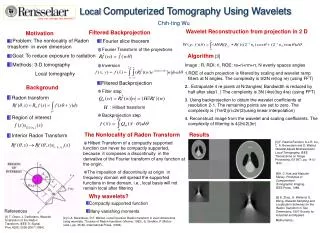
Local Computerized Tomography Using Wavelets Chih-ting Wu Wavelet Reconstruction from projection in 2 D Motivation Filtered Backprojection • Problem: The nonlocality of Radon trnasform in even dimension • Goal: To reduce exposure to radiation • Methods: 3-D tomography • Local tomography • Fourier slice theorem • Fourier Transform of the projections • Inversion • Filtered Backprojection • Filter step • : Hilbert transform • Backprojection step Algorithm [3] • Image : R, ROI: ri, ROE: re=ri+rm+rr, N evenly spaces angles • ROE of each projection is filtered by scaling and wavelet ramp filters at N angles. The complexity is 9/2N re(log re) (using FFT) • . Extrapolate 4 re pixels at N/2angles( Bandwidth is reduced by half after step1. ) The complexity is 3N (4re)(log 4re) (using FFT) • 3. Using backprojection to obtain the wavelet coefficients at resolution 2-1. The remaining points are set to zero. The complexity is (7re/2)(ri+2rr)2(using linear interpolation) • 4. Reconstruct image from the wavelet and scaling coefficients. The complexity of filtering is 4(2ri)2(3rr) Background • Radon transform • Region of interest • Interior Radon Transform The Nonlocality of Radon Transform Results • Hilbert Transform of a compactly supported function can never be compactly supported, because it composes a discontinuity in the derivative of the Fourier transform of any function at the origin. • The imposition of discontinuity at origin in frequency domain will spread the supported functions in time domain, i.e., local basis will not remain local after filtering [3] F. Rashid-Farrokhi, K.J.R. Liu, C. A. Berenstein and D. Walnut: Wavelet-based Multiresolution Local Tomography, IEEE Transactions on Image Processing, 6(1997), pp. 1412-1430. [4]A. C. Kak and Malcolm Slaney, Principles of Computerized Tomographic Imaging, IEEE Press, 1988. Why wavelets? [5] S. Zhao, G. Welland, G. Wang, Wavelet Sampling and Localization Schemes for the Radon Transform in Two Dimensions, 1997 Society for Industrial and Applied Mathematics. • Compactly supported function • Many vanishing moments References [1] T. Olson, J. DeStefano, Wavelet localization of the Radon Transform, IEEE Tr. Signal Proc.42(8): 2055-2067 (1994). [2] C.A. Berenstein, D.F. Walnut, Local inversion Radon transform in even dimensions using wavelets, 75 years of Radon transform (Vienna, 1992), S, Gindikin, P. Michor (eds.), pp. 45-69, International Press, (1994).