Preliminary Data Analysis and Simulation Comparison of Balloon Flight Experiment for GLAST
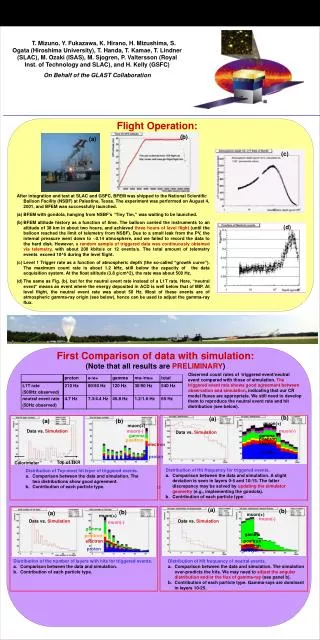
This study details the first flight operation of the Balloon Flight Experiment Module (BFEM) conducted on August 4, 2001. Following successful integration and testing at SLAC and GSFC, BFEM was launched from the National Scientific Balloon Facility in Texas. The experiment achieved an altitude of 38 km, recording substantial telemetry data despite a pressure leak. We analyze the triggered and neutral event rates, comparing them with simulation results, revealing good agreement for triggered events, while highlighting discrepancies in neutral event modeling that require further adjustments.

Preliminary Data Analysis and Simulation Comparison of Balloon Flight Experiment for GLAST
E N D
Presentation Transcript
T. Mizuno, Y. Fukazawa, K. Hirano, H. Mizushima, S. Ogata (Hiroshima University), T. Handa, T. Kamae, T. Lindner (SLAC), M. Ozaki (ISAS), M. Sjogren, P. Valtersson (Royal Inst. of Technology and SLAC), and H. Kelly (GSFC) On Behalf of the GLAST Collaboration Flight Operation: (b) (a) (c) • After integration and test at SLAC and GSFC, BFEM was shipped to the National Scientific Balloon Facility (NSBF) at Palestine, Texas. The experiment was performed on August 4, 2001, and BFEM was successfully launched. • BFEM with gondola, hanging from NSBF’s “Tiny Tim,” was waiting to be launched. • BFEM altitude history as a function of time. The balloon carried the instruments to an altitude of 38 km in about two hours, and achieved three hours of level flight (until the balloon reached the limit of telemetry from NSBF). Due to a small leak from the PV, the internal pressure went down to ~0.14 atmosphere, and we failed to record the data to the hard disk. However, a random sample of triggered data was continuously obtained via telemetry, with about 200 kbits/s or 12 events/s. The total amount of telemetry events exceed 10^5 during the level flight. • Level 1 Trigger rate as a function of atmospheric depth (the so-called “growth curve”). The maximum count rate is about 1.2 kHz, still below the capacity of the data acquisition system. At the float altitude (3.8 g/cm^2), the rate was about 500 Hz. • The same as Fig. (b), but for the neutral event rate instead of a L1T rate. Here, “neutral event” means an event where the energy deposited in ACD is well below that of MIP. At level flight, the neutral event rate was about 50 Hz. Most of these events are of atmospheric gamma-ray origin (see below), hence can be used to adjust the gamma-ray flux. (d) O First Comparison of data with simulation: (Note that all results are PRELIMINARY) Observed count rates of triggered event/neutral event compared with those of simulation. The triggered event rate shows good agreement between observation and simulation, indicating that our CR model fluxes are appropriate. We still need to develop them to reproduce the neutral event rate and hit distribution (see below). (b) (a) (a) (b) muon(+) muon(+) Data vs. Simulation muon(-) muon(-) Data vs. Simulation gamma gamma positron positron electron electron proton proton Top of TKR Calorimeter • Distribution of Hit frequency for triggered events. • Comparison between the data and simulation. A slight deviation is seen in layers 0-5 and 10-15. The latter discrepancy may be solved by updating the simulator geometry (e.g., implementing the gondola). • Contribution of each particle type. • Distribution of Top-most hit layer of triggered events. • Comparison between the data and simulation. The two distributions show good agreement. • Contribution of each particle type. (a) (b) (b) (a) muon(+) muon(+) muon(-) Data vs. Simulation Data vs. Simulation muon(-) gamma gamma positron electron positron electron proton proton • Distribution of the number of layers with hits for triggered events. • Comparison between the data and simulation. • Contribution of each particle type. • Distribution of Hit frequency of neutral events. • Comparison between the data and simulation. The simulation over-predicts the hits. We may need to adjust the angular distribution and/or the flux of gamma-ray (see panel b). • Contribution of each particle type. Gamma-rays are dominant in layers 10-25.