Understanding Figurative Language and Literary Elements in Literature
Explore the intricacies of figurative language including similes, metaphors, hyperboles, and personification. Understand symbolism and the significance of roots, prefixes, and suffixes in enhancing meaning. Delve into the elements of narrative such as setting, conflict, plot structure, and character development. Learn the importance of dialogue, tone, voice, and point of view in storytelling. Discover various poetic forms and the elements that distinguish poetry from prose. Equip yourself with effective text structures and summarizing techniques to enhance comprehension and engagement.


Understanding Figurative Language and Literary Elements in Literature
E N D
Presentation Transcript
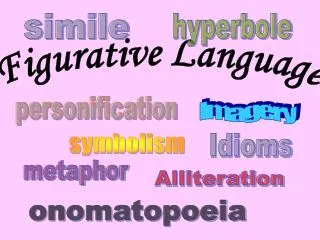
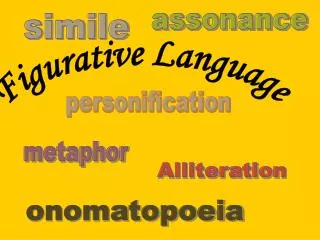
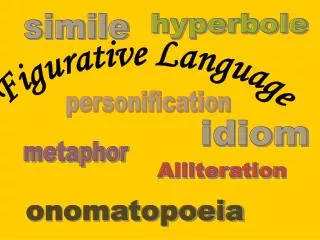
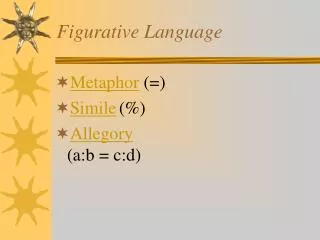
Figurative Language • Simile • Metaphor • Hyperbole • Personification
Symbolism • Symbolism is
Analogies • Analogies are
Reference Materials • Dictionary • Thesaurus • Glossary • Index
Context Clues • Context clues are • Follow these steps to use context clues
Setting • Setting is
Elements of Plot • Exposition is • The initiating event is • The rising action is • The climax is • The falling action is • The resolution is
Climax- Falling action- Rising Action- Initiating Event- Exposition- Resolution-
Theme • Theme is
Subplot • Subplot is • An example of subplot is
Dialogue • Dialogue is
Tone • Tone is serious- solemn- sarcastic- objective-
Tone (pt. 2) enthusiastic - humorous- hostile- disapproving- personal- impersonal-
Voice • Voice is
Point of View • 1st Person • 3rd Person Limited • 3rd Person Omniscient
Literary Devices • Foreshadowing • Irony • Flashback
Poetic Forms • Haiku • Limerick • Ballad
Poetic Forms (pt.2) • Free Verse • Couplet • Quatrain
Elements of Poetry and Prose • Rhyme • Rhythm • Meter
Elements of Poetry and Prose (pt. 2) • Repetition • Alliteration • Onomatopoeia
Author’s Purpose • Entertain • Persuade • Inform
Text Structure • Cause and Effect • Comparison/Contrast • Enumeration or Listing
Text Structure (pt. 2) • Sequential or Chronological • Concept/Definition • Generalization • Process
Summarizing • Summarizing is
Main Idea • The main idea is