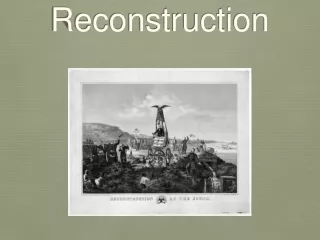
Reconstruction
The Reconstruction Era (1865-1877) was a turbulent period of political reform following the Civil War. It aimed to address the devastation faced by the Southern states and the integration of 3.5 million formerly enslaved individuals into society. President Lincoln's lenient plan shifted to more stringent Congressional measures under Radical Republicans advocating for civil rights and economic opportunities for African Americans. Various groups emerged, facing opposition like Black Codes and Andrew Johnson’s leniency. Ultimately, the era's challenges led to significant social and political changes in America.

Reconstruction
E N D
Presentation Transcript
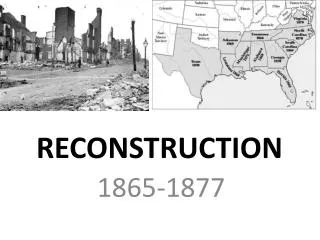
Reconstruction 1865-1877
Background • Political reform movement following Civil War • Involved Presidents and members of Congress • Different groups emerge and push for different aims for Reconstruction • At end of Civil War = over 600,000 dead, South’s economy destroyed, what to do with 3.5 million former slaves?
Overview… • Three rounds of Reconstruction • First: Presidential (Lincoln, Johnson) • Second: Congressional (Radical Republican) • Third: Redemption (Southern Conservatives)
Reconstruction: Lincoln’s Plan • The process of putting the nation back together following the Civil War • Lincoln’s Plan (viewed as lenient) • 1863 – Proclamation of Amnesty and Reconstruction • Ten% of voters in Confed. states had to • Accept emancipation • Swear loyalty to the Union • High ranking Confed. officials could not vote or hold office unless pardoned by President • Once conditions were satisfied, a state could return to the Union • Lenient because Lincoln wanted to make it easy to return
Wade-Davis Bill (1864) • Congress's plan: • 50% must take oath • Only non-Confederates allowed to vote for state-constitution • Pocket vetoed by Lincoln Benjamin Wade Henry Davis
Influential Individuals of Reconstruction • Members of Congress – Radical Republicans • Thaddeus Stevens • Charles Sumner • Andrew Johnson – VP; assumed office after Lincoln dies
Radical Republicans • Goals: • Punish the South for causing the Civil War • Fought to protect the rights of former slaves • Thaddeus Stevens • Focused on economic opportunities for former slaves • Distribute land to former slaves • Charles Sumner • Focused on citizenship and political rights for former slaves
Andrew Johnson • Former Senator from TN; VP for Lincoln • TN part of Confederacy but Johnson remained loyal to Union • A democrat; Reconstruction plan similar to Lincoln’s • Issued 13,000 pardons • Unconcerned with rights of former slaves as states began to pass black codes
Black Codes • Laws that established conditions similar to slavery for black Americans • African Americans couldn’t leave plantations, restrictions on racial intermarriage, not able to serve on juries or testify against whites in court
Black Codes • Prohibited blacks from renting land or borrowing money to buy land • Forced freedmen to sign work contracts • Prohibited blacks from testifying against whites
Freedman’s Bureau • Johnson opposed to organization • Oversaw relief efforts designed to aid former slaves • Established schools, provided medical supplies, food, clothing • Helped to reunite families separated under slavery • Congress voted to extend funding but Johnson vetoed renewal
Impeachment • 1868 • Impeachment: to bring official charges against the President (majority vote in HoR) • Trial/Removal: The President stands trial (Senate acts as jury; 2/3 majority vote needed for removal) • Remained President but largely ineffective following trial
Congressional Reconstruction • Congress took control of Reconstruction and began implementing actions to punish South • Reconstruction Acts (1867-1868): • Former Confederate States were militarily occupied by U.S. troops • 5 military districts; only TN not part of occupation (already ratified 14th in 1866) • States could re-enter the Union once they ratified the 14th Amendment
Congressional Reconstruction • Reconstruction Act of 1867 • South under military occupation
13th Amendment • “Neither slavery nor involuntary servitude, except as a punishment for a crime whereof the party shall have been duly convicted, shall exist within the United States, or any place subject to their jurisdiction.” • Prohibited slavery
14th Amendment • All persons born in the US are citizens of the US • All citizens are guaranteed equal treatment under the law • Punished states that denied adult males the right to vote
15th Amendment • Guaranteed the right to vote for African Americans
Limits to Reconstruction • Civil War Amendments were a success; however, there was no redistribution of land and most former slaves lived as sharecroppers and had little economic opportunity
Reforms after Grant’s Election • Election of 1868 Black votes the difference!
Reconstruction in the South • Scalawags – Southern Republicans • Carpetbaggers – northerners who went south • African-American legislators
North During Reconstruction • Grant Administration scandals (e.g. Credit Mobilier Affair, Whiskey Ring) discredits itself • Local politics crazy too… Boss Tweed & Tammany Hall
Panic of 1873 • Over speculation on industry and railroads leads to depression • Debtors demanded inflationary greenbacks • Grant vetoed release of more greenbacks
1876 Election • Helped end Reconstruction • Two candidates: • Samuel Tilden: Dem. From NY; political reformer • Rutherford B. Hayes: Rep.; former OH Gov. • SC, FL, LA voter irregularity; both claimed to win
Election of 1876 • Closely contested…
Wormley Hotel, D.C. • Electoral Commission • 7 Dems. • 8 Repub. • Compromise of 1877 • Hayes is President (pleases North) • Military occupation ended in the South (please white Southerners) • Rights of former slaves not protected • Hayes would support building southern transcontinental railroad
Respond in your journal: • 1. Brainstorm a response: To what extent was Reconstruction a political success or failure? • 2. Create a thesis that responds to the prompt • 3. Write your intro. Paragraph – to be collected at