Factoring Quadratic Equations: Step-by-Step Guide to Finding Roots
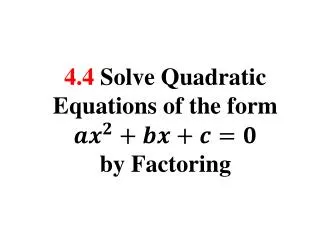
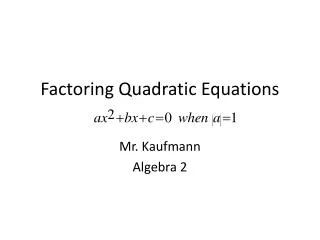
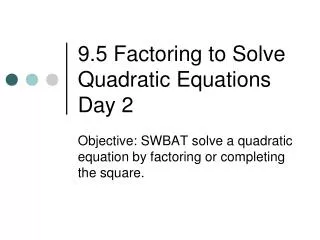
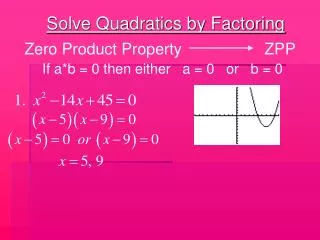
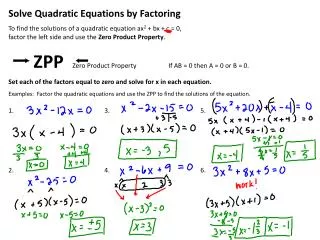
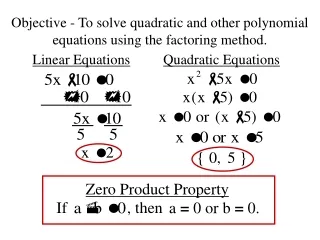
This guide provides a clear methodology for solving quadratic equations through factoring. Begin by rearranging the equation into standard form (ax² + bx + c = 0). Explore various examples, including quadratic equations such as x² - x - 12 = 0 and 4x² + 23x + 15 = 0, demonstrating the step-by-step process of factoring. Each example shows how to set factors equal to zero to find the roots. For further practice, check your homework on specific problems from the designated page.

Factoring Quadratic Equations: Step-by-Step Guide to Finding Roots
E N D
Presentation Transcript
Factoring to Solve Equations Date: ___________
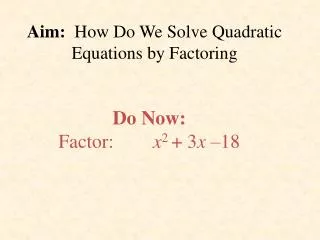
Example 1: Solve Steps: Rearrange the question so it is in standard form (ax2 + bx + c = 0) a) x2 – x = 12 2. Factor the quadratic. x2 – x – 12 = 0 Set each bracket = 0 and solve to find the roots. (x – 4)(x + 3) = 0 x + 3 = 0 x – 4 = 0 A -1 M -12 -4 3 x = -3 x = 4 b) 4x2 = – 23x – 15 4x2 + 23x + 15 = 0 A 23 M 60 20 3 4x2 + 20x + 3x + 15 = 0 4x(x + 5) + 3(x + 5) = 0 (x + 5)(4x + 3) = 0 Don’t forget the =0 each time 4x + 3 = 0 x + 5 = 0 x = - ¾ x = -5
You don’t use the 2 since it is the ‘a’ value. It is just the vertical stretch! c) 2(x – 1)(x + 5) = 0 x – 1 = 0 x + 5 = 0 x = -5 x = 1 d) 2x (x + 7) = 0 x = 0 x + 7 = 0 x = -7 e) 3x(x – 2) = 105 A -2 M -35 -7 5 3x2 – 6x – 105 = 0 3(x2 – 2x – 35) = 0 3(x – 7)(x + 5) = 0 x = 7 x = -5 Your homework is Pg. 279 # (2 – 6) a,c, 7, 8, 11, 13, 14