Mastering Knowledge Management Systems: Building a Framework for Organizational Excellence
Explore the foundations and practices of Knowledge Management (KM) within organizations. Dive deep into data processing, information analysis, and knowledge interpretation to enhance decision-making and operational efficiency. Analyze the impact of technology and human collaboration on KM strategies. Discover the nuances of different knowledge types and their application in diverse contexts.

Mastering Knowledge Management Systems: Building a Framework for Organizational Excellence
E N D
Presentation Transcript
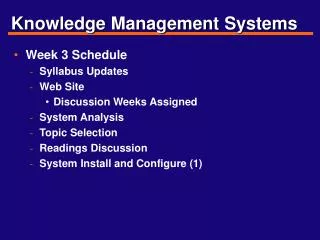
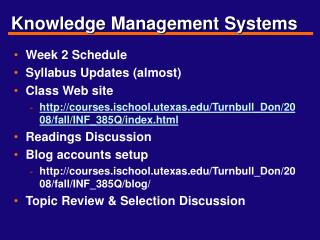
Knowledge Management Systems • Week 2 Schedule • Syllabus Updates (almost) • Class Web site • http://courses.ischool.utexas.edu/Turnbull_Don/2008/fall/INF_385Q/index.html • Readings Discussion • Blog accounts setup • http://courses.ischool.utexas.edu/Turnbull_Don/2008/fall/INF_385Q/blog/ • Topic Review & Selection Discussion
Blog Setup • http://courses.ischool.utexas.edu/Turnbull_Don/2008/fall/INF_385Q/blog/ • Let’s walk through a blog post • Blog content • Commentary with your own thoughts • Analysis of someone else’s ideas • Fellow class members • About our class readings • From another web page or blog post • Recommendations (with explanation & commentary • Links to other web pages or blog posts • Referring to other information sources • People, meetings, news, software… • Queries for help or discussion • Ask others for their insights into an issue or problem
Questions to Consider • What is KM? • What Does KM Provide? • Personal • Organizational • Best Approaches for KM? • Is KM a process? • Who Does KM? • Contexts: • Culture • Environment • Change • Cooperation
Working Knowledge • What Do We Talk About When We Talk About Knowledge? • The Promise and Challenge of Knowledge Markets • Knowledge Generation • Knowledge Coordination and Codification • “the only unlimited resource” – Paul Romer • Book context • 1998 (1997-1996) • Based on consulting experiences • Consulting tool (optimism)
Personal & Organizational KM • The organization is no longer a “black box” • Study & improvement of the processes & outcomes (but more subtle than Taylorism) • An increased focus on knowledge is the result of a more abstract, services, information economy • In G8+ countries only? (by definition?) • The cause of outsourcing? • Mobility of the workforce & lack of organizational stability places more focus on “the value of something once it is gone” (p. x) • Technology is often thought to replace people
KM is asking questions • What do you need to know? • What would you do better next time? • Who knows what? • How can you work together? • How can you add value to information (with knowledge)? • How can you measure or manage this knowledge? • KM is a framework for asking & analyzing thought as external work.
Tools and KMS • Information Technology has enabled a promise that knowledge can be managed, captured, measured and transferred. • Speed of Transfer • SIGs and User Groups • Too Fast? • Measurement of Knowledge? • Quantitative and Qualitative • Decision Making • Economics of Knowledge • Nobel Prize(s) • Business Process Modeling
Knowledge Boom? • Who are the Knowledge Wildcatters? • What are the Knowledge Syndicates? • Knowledge De-Regulation? • What was going on before the boom? • Knowledge Vacuum • Noticing lost knowledge because it is gone. • Working to improve organizational performance. • Driven by Technology? • IT as a means? • IT as a workplace paradigm shifter?
Path to Knowledge • Data • Information – Added Value • Contextualized: purpose data is gathered • Categorized: key components recognized • Calculated: analyzed • Corrected: error free • Condensed: summarized • “the difference that makes a difference” – Bateson • Knowledge • Action (decisions) • Experience (wisdom) • What isn’t knowledge?
Types of Knowledge (in Action) • Defining knowledge by how it is used • What other ways to identify knowledge? • Experience • Individuals • Groups • Cultures • Ground Truth • Situational • Active (evolving) • Complexity • Plastic • Subtle • Sensemaking - Interpretation
Types of Knowledge 2 • Rules of Thumb and Intuition • Heuristics • Procedures • “Scripts” • Goals (shared) • Intuitions (“compressed expertise”) • How are these different from person to person, from org to org?
Subtle Knowledge • Cultural values • Beliefs • Technology fixes • Individual orientation • Group building & consensus • “Beliefs and Commitment” – Nonaka & Takeuchi • Define the organization
BP Virtual Teamwork • Understanding work over efficiency gains • Distributed culture & understanding • K originates & resides in people’s minds • K sharing requires trust • Technology enables new K behaviors • K sharing must be encouraged & rewarded • Management support is essential • Use pilot programs for KM introduction to the org • Measure the pilot programs (show success) • Encourage creativity
Knowledge Interpreted • Is Knowledge a Product or a Service? • What isn’t Knowledge once interpreted? • That Difference that makes you more Competitive? • Knowledge is the main difference, the principle advantage. • Technologies eventually evens out • The changes to culture and individuals don’t. • Information Technology can enable changes that last beyond their influence. • Networked Knowledge • Networked Organization
Knowledge & Teams • Can a large organization be as effective as a smaller one? • Do larger organizations have a higher percentage of available knowledge? • Is knowledge more important than speed? • What difference does technology make? • Speed of decision making? • Cultural context for communication? • Space and Time are less of a constraint • Less focus on mechanics of work, more focus on knowledge use & creation?
Knowledge Markets • Economists moving into KM? • Markets Mean Measurement • KM Mutual Fund? • KM Index Fund? • Political Economy of Knowledge Markets • Organizations • Individual Roles • Buyers • Sellers • Brokers (Gatekeepers) • Types of costs, perceived value • Competition
Knowledge Economy • Value & Pricing (p 31) • Current Value • Future Value • Current Investment • Future Investment • Reciprocity • Repute • Altruism • Trust • Signals
Knowledge Market (In)Efficiencies • Is there ever a perfect market? • What is the KM equivalent of “Irrational Exuberance”? (Greenspan, Shiller) • Incompleteness • Where is the Knowledge? • Who sets the price? • Asymmetry • One Department, One Person • Localness • Neighbors • Peers • “Satisficing” (Simon and March)
Knowledge Market Pathologies • Do these naturally occur? • Monopolies • Technological • Organizational • (Artificial) Scarcity • Recency • Frequency • Trade Barriers • IT • Personnel • Culture • Building Marketplaces • Shopping Time to mingle, browse and famliarize • Cultural Shift to a knowledge market • Technological Shift to doing this with IT
Information as Product • “The Age of Also” • Options are Golden Handcuffs • End in Itself • Prosumption • The Age of User Groups (Teach & Learn at Once) • Society and Consumers (Precision & Repetition) • Information Presentation • Medium is the Message • Varieties of Literacy • The Internet Changes Everything? • Empowerment? (Value) • Speed? Expectations
Knowledge Generation • “Innovation Department”? • Acquisition • Rental • Processes • R & D • Fusion • Adaptation • Innovation • Resource Allocation
Knowledge Codification • Identifying knowledge means knowing what you should be doing • Goals for Codified Knowledge: • Decide business goals needing knowledge • Identify Knowledge in various forms to reach goals • Evaluate Knowledge for Utility and Codification • Resolve Medium for Codification and Access
Types of Knowledge • Tacit Knowledge • Internalized • “Not Known” • Serendipitous • Difficult to Capture • Explicit Knowledge • Externalized • Easily Found • Permanent • Difficult to Process for Utility
Capturing Knowledge • Maps • Narratives • Surveys • Measurement as Capture • Anthropology • Technology
Coordinating Knowledge • Communities (of Practice) • Networks • Knowledge Marketplace Evaluation • IT R&D • Knowledge Packet Tracing
Next week • Experiment with collaborative technologies • Use blog to discuss the Working Knowledge chapters 5 & 6 • Use the listserv to discuss Working Knowledge chapter 7 & 8 • Counts toward class participation • Quick review of readings, including the Tiwana article the week after