
Solving Polynomial and Vertical Motion Equations: Steps and Examples
E N D
Presentation Transcript
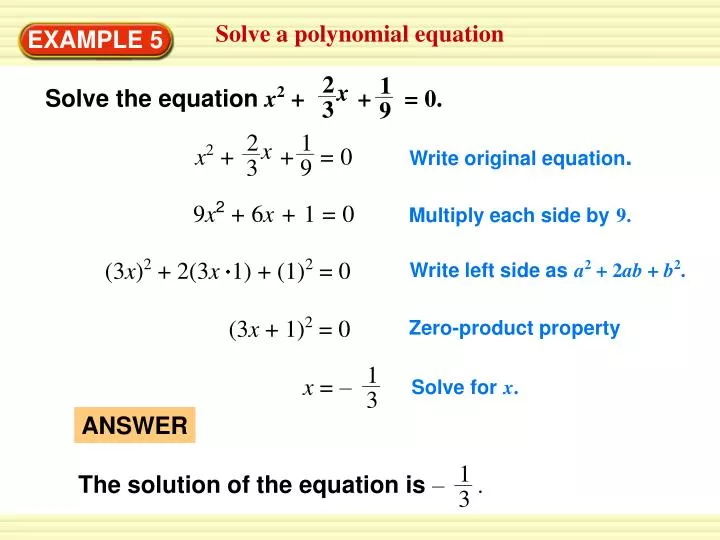
ANSWER x2++=0 x x 1 1 2 1 1 2 The solution of the equation is–. (3x)2 + 2(3x 1) + (1)2 = 0 3 3 9 3 9 3 x =– Solve a polynomial equation EXAMPLE 5 Solve the equationx2 ++=0. Write original equation. 9x2+6x+1=0 Multiply each side by9. Write left side asa2 + 2ab + b2. (3x + 1)2 = 0 Zero-product property Solve forx.
Solve a vertical motion problem EXAMPLE 6 FALLING OBJECT A window washer drops a wet sponge from a height of 64 feet. After how many seconds does the sponge land on the ground? SOLUTION Use the vertical motion model to write an equation for the height h(in feet) of the sponge as a function of the time t(in seconds) after it is dropped.
t = 2 or t = –2 or t – 2 = 0 t + 2 = 0 The sponge lands on the ground 2 seconds after it is dropped. ANSWER Solve a vertical motion problem EXAMPLE 6 The sponge was dropped, so it has no initial vertical velocity. Find the value of t for which the height is 0. h = –16t2 + vt + s Vertical motion model 0 = –16t2 + (0)t + 64 Substitute 0 for h,0 for v, and 64 for s. Factor out–16. 0 = –16(t2 – 4) 0 = –16(t – 2)(t +2) Difference of two squares pattern Zero-product property Solve fort. Disregard the negative solution of the equation.
n = – 9 or n = 9 for Examples 5 and 6 GUIDED PRACTICE Solve the equation a = –3 5. a2+6a+ 9 = 0 6. w2–14w+49 = 0 w = 7 7. n2–81=0
The sponge lands on the ground 1 second after it is dropped. ANSWER for Examples 5 and 6 GUIDED PRACTICE 8. WHAT IF? In Example 6, suppose the sponge is dropped from a height of 16 feet. After how many seconds does it land on the ground?