Download
1 / 29
310 likes | 436 Vues
This comprehensive overview explores the future of coral reefs, emphasizing the importance of their conservation for therapeutic compounds and global ecosystems. The document discusses the vital role of coral reefs in therapeutic advancements and economic sectors like tourism and food. It analyzes coral bleaching and the disruption of symbiotic relationships, detailing the responses of reef organisms to environmental stressors and disturbances. By understanding the dynamics of competition, predation, and recovery, we can assess these ecosystems' resilience and design effective conservation strategies.

E N D
Coral/algal Reefs III The future?
Utilitarian justification for reef conservation • Therapeutic compounds from marine species • Anti-virals from sponges, seagrass • Anti-tumor compounds from tunicate, dogfish, bryozoan, sea hares, cyanobacteria, sponge • Compounds to promote bone grafts from stony corals • Tourism • Food • Impact on global climate, carbon exchange • Models for scientific study
Processes important in reef dynamics – what maintains the reef structure? • Symbiotic mutualism (and dissolution of associations) • Competition • Predation and grazing • Disturbance & recovery
Questions: • Are symbiotic relationships increasingly disrupted? • What are the consequences? • How are organisms linked through symbiosis? • Are changes reversible?
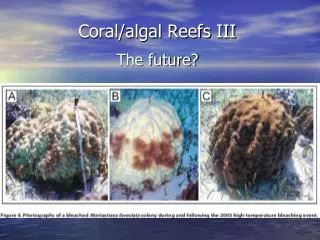
Coral bleaching – dissolution of symbiosis • zooxanthellae expelled from tissue • polyp can persist – for a while • new associations can be formed • responses to stresses
A general introduction to “symbiosis” • De Bary (1850’s) – “The living together of different species for an extended period of time.” • Proximity, not outcomes, define symbiosis • Variation in characterizing some associations, e.g., pollination
Symbiosis has many dimensions • Form of physical association • Types of organisms involved • Nature of the exchange or influence • Outcomes of the interaction (+, 0, -) • Degree of dependence • Evolutionary derivation of the association
Physical nature of the association • Close proximity, but physically independent • External contact • Internal
What taxa are associated? • Algae-invertebrate • Among animals • Bacteria/archaea - animals
What are the outcomes of symbiotic associations? • Recipient
Outcomes: nutrient exchange • What is the evidence for exchange with endosymbioticdinoflagellates? • Experiment: remove zooxanthellae • ammonium content of polyp rises • For Tridacna clams • experimentally enrich with ammonium • algal symbiont increases in density
What is the degree of dependence? • Facultative • Obligate (often has very specialized morphology and life history) • Symmetry is not necessarily found
What is the evolutionary origin of the association? • Parasite-host may evolve to be mutualistic • Predator-prey (coral/dinoflagellate) • Close proximity may lead to coevolved relationship
How can we evaluate importance? • Removal experiments, e.g., cleaner fish • Alter background conditions – Chlorella/Hydra experiment
How does heat (& light) disrupt mutualism? • Symbiodinium is damaged by oxidative stress
Coral Responses • Polyp responds immunologically • Apoptosis & autophagy • Zooxanthellae can be expelled • Polyp switches to heterotrophy • This is a short-term strategy
Sensitivity to SST varies • Among genotypes of Symbiodinium • Among colonies within coral species • Between different coral species • Geographically for the same coral species
Brandt, M. E. 2009. The effect of species and colony size on the bleaching response of reef-building corals in the Florida Keys during the 2005 mass bleaching event. Coral Reefs 28:911-924. • Background • Summer & fall, 2005 – high SST in ne Caribbean • Mass bleaching documented • Methods • Monitor corals for 191 colonies in permanent quadrats
Why and what’s next? • Symbiont “clades” vary genetically • Corals can switch • Symbiodinium communities can vary across environmental gradients • Degree of flexibility is debated • Hosts (corals) also vary • Different fluorescent proteins for protection • Different abilities in heterotrophy • Coral structure affects the light environment
Competitive dynamics • Exploitation competition (for light) • Upright, branching corals can shade massive corals • Encrusting algae can spread over corals • Interference competition (for space) • External digestion by some corals • “Sweeper” tentacles for some species • Hierarchy of competitive dominance • Algae easily overgrow most corals • Among corals Pocillopora is nastiest
Dynamics of predation on coral reef species • Coral-feeding fish are present but usually not devastating • Territorial damselfish create safe zones (up to 60% of surface area) • Coral-feeders have their own predators • Starfish, such as “Crown-of-Thorns” can be problematic • Population “outbreaks” can damage living corals
Dynamics of grazing on algal reef species • Urchins are major consumers (e.g., Diadema antillarum) • Grazing by herbivorous fish can be specialized on algae (more impact than fish feeding on corals) • Grazing can suppress competitively dominant algae • Indirect effects can become important