Future energy communities
This study investigates the impact of social factors on the acceptability of smart energy systems within future energy communities. By exploring the interplay of individual and group norms through Value-Belief-Norm Theory, the research reveals how injunctive and personal norms influence energy behavior. Utilizing a sample of 110 participants, the findings indicate significant correlations that suggest the importance of internalized norms and group identification in fostering long-term commitment to sustainable energy practices. The study emphasizes the need for local energy initiatives to navigate social dynamics effectively.

Future energy communities
E N D
Presentation Transcript
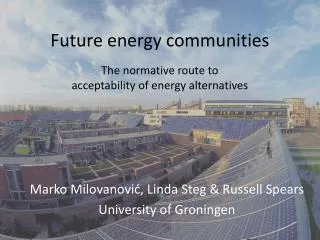
The normative route toacceptability of energy alternatives Future energy communities Marko Milovanović, Linda Steg & Russell Spears University of Groningen
Goal study • Study the effects of social factors on acceptability of smart energy systems • Future landscape: local energy initiatives
Energy transitions • Individual approach • Value Belief NormTheory • Social approach • Normative route • Group norms Personal norms
Method • Sample N = 110 (58 male, 51 female), Age: M = 44.3 years, SD = 11.2 • Acceptability 2 items, α = .89 • Injunctive Norm 1 item • Personal Norm 3 items, α = .81 • Group-id: Self-stereotyping 2 items, α = .80
The normative route toacceptability R2 = .166 b = .460, p < .001 IN Acc
The normative route toacceptability R2 = .257 b = .246, p = .033 IN Acc b = .540, p < .001 b = .397, p = .001 PN
The normative route toacceptability R2 = .257 b = .246, p = .033 IN Acc b = .397, p = .001 PN grID b = .124, p = .048
The normative route toacceptability R2 = .268 b = .216, p = .067 IN Acc b = .687, p < .001 b = .365, p = .001 b = .427, p < .001 PN
Conclusion Internalizednorms Long-term commitment
Thank you for your attention! Questions?