Understanding Influenza Transmission: Contact, Droplet, and Aerosol Pathways
This overview explains the transmission modes of influenza, categorized into contact, droplet spray, and aerosol routes. Contact transmission includes direct transfer from an infected person or indirect transfer via contaminated objects, with hands playing a crucial role. Droplet spray transmission involves person-to-person spread through airborne droplets impacting exposed mucous membranes. Aerosol transmission refers to smaller particles that can be inhaled deeply into the respiratory tract. Understanding these pathways is essential for effective prevention and control of influenza outbreaks.

Understanding Influenza Transmission: Contact, Droplet, and Aerosol Pathways
E N D
Presentation Transcript
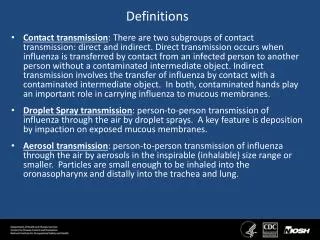
Definitions • Contact transmission: There are two subgroups of contact transmission: direct and indirect. Direct transmission occurs when influenza is transferred by contact from an infected person to another person without a contaminated intermediate object. Indirect transmission involves the transfer of influenza by contact with a contaminated intermediate object. In both, contaminated hands play an important role in carrying influenza to mucous membranes. • Droplet Spray transmission: person-to-person transmission of influenza through the air by droplet sprays. A key feature is deposition by impaction on exposed mucous membranes. • Aerosol transmission: person-to-person transmission of influenza through the air by aerosols in the inspirable (inhalable) size range or smaller. Particles are small enough to be inhaled into the oronasopharynxand distally into the trachea and lung.