Pediatric Planning Resources
This document serves as a comprehensive primer for pediatric emergency planning, developed by the Minnesota Department of Health. It includes templates, checklists, and supporting appendices that guide healthcare facilities in creating pediatric Mass Casualty Incident (MCI) plans. Key resources provided are the Pediatric Safe Area Checklist, training scenarios, and communication strategies. The document emphasizes collaboration among regional planning teams, training programs, and effective equipment management to ensure the safety and well-being of children during emergencies.

Pediatric Planning Resources
E N D
Presentation Transcript
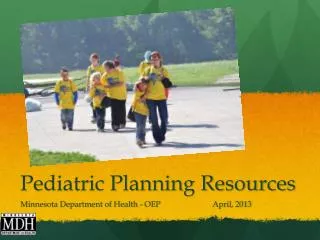
Pediatric Planning Resources Minnesota Department of Health - OEP April, 2013
What’s the plan? • Primer • Template • Supporting appendices
Appendix • Pediatric Safe Area Checklist • Sample disaster menus • Behavioral health handout • Pediatric priorities poster • Pediatric referral resources • Hospital training matrix • Hospital training scenarios • Template pediatric MCI annex • JAS – Pediatric Technical Specialist • JAS – Pediatric Services Supervisor • JAS – Pediatric Safe Area Unit Leader • Safe area registry template • Registration form
10 Steps – Facility Planning • Determine expertise among staff • Create staff leadership positions • Write a peds MCI annex • Training and Exercise plan • Equipment plan • Nutrition plan • Pharmaceutical plan • Security / safety needs addressed • Transfer / transport • Pediatric decontamination considerations
8 Steps – Regional Planning • Assess regional expertise and leadership • Determine training needs and support/resources • Assess regional capacity • Assess equipment needs / issues • Regional referral and transportation plan • Behavioral health resource assessment • Family Assistance Center concept of operations • Exercise plan
Regional Implementation • Regional roll-out • Educational offerings • Workshops • Partner facilities • Follow up • Trauma system
CO-S-TR – C4 • Command • Control • Communications • Coordination
CO-S-TR - Logistics • Space • Triage • Red • Yellow • Green (ambulatory) • Pediatric Safe Area • Inpatient
CO-S-TR - Logistics • Staff • Who has expertise / training? • Who needs additional training? • Didactic – classes? • Practical – classes? simulation? • Refresher – emphasis on bedside, brief, using usual equipment • Just-in-time
Stuff! • Based on AAP / ACEP guidelines • Per ‘red’ patient • Some equipment is per facility • Nothing too fancy! • Fits well with trauma preparedness / site visits
CO-S-TR - Logistics • Stuff (other) • Beds / pack-n-plays • Pharmaceuticals • Potential for errors! • Weight-based dosing
CO-S-TR Logistics • Special • Behavioral Health • Family / Safe Area • Infectious Disease • Decontamination
CO-S-TR - Operations • Triage
CO-S-TR - Operations • Treatment • Outpatient – release to pediatric safe area • Inpatient • Cohorting – kids with kids only! • Priority transfer or pediatric-specific unit: • More serious injuries/illness • Complex underlying diseases • Age <8
CO-S-TR - Operations • Transport • Internal • Stretchers • Car seats, cribs, etc. • Supervision! • External • Ambulances – specialized, ALS/BLS, rotor, fixed wing • Other vehicles – school bus, cars with car seats
CO-S-TR - Operations • Tracking • Registration • Wristband • Purple - parent • White – without parent • Blue – belongs to staff • Patient wristband may be used with above
Appendix – Behavioral Health • Age <5 • Age 6-11 • Age 12-18 • Handout – what to expect, when to seek help
Appendix - Template • Annex to the facility EOP • Pediatric Mass Casualty Plan • Pediatric Emergency Team (PET)
Appendix - JAS • Pediatric Technical Specialist • Pediatric Services Supervisor • Pediatric Safe Area Unit Leader
Appendix – Registry • Check-in, check-out • Registration