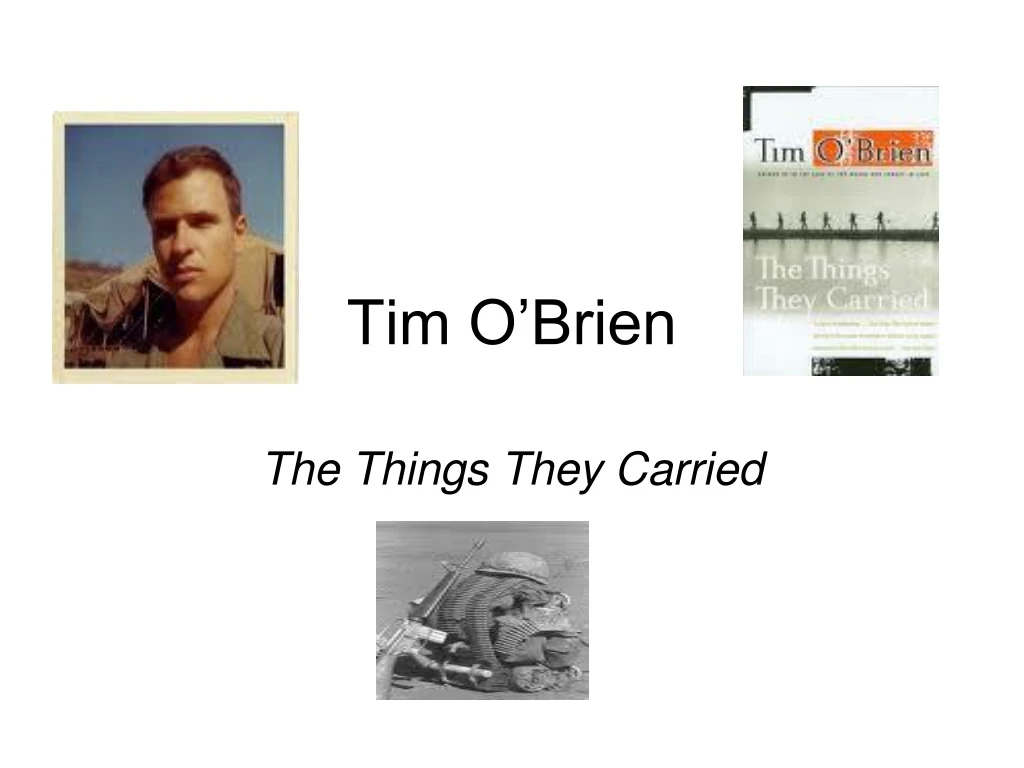

Tim O’Brien
E N D
Presentation Transcript
Tim O’Brien The Things They Carried
Overview • Tim O’Brien writes stories primarily about his experience in the Vietnam War 1969-1970 • “The war and its enduring personal legacy has provided enough material to fill six books.” • Perhaps the most popular of these six is The Things They Carried
O’Brien’s Personal Background • Raised in a conservative area of America- Worthington, Minnesota. • Both his parents served in the United States Navy during World War II. • His conservative family greatly influenced his decision to go to Vietnam despite his serious doubts about the war.
O’Brien’s College Years • Graduated with honors from Macalester College in 1968 • Class president • Participated in anti-Vietnam War rallies • Received a full scholarship to Harvard Grad. School • Drafted before he could enroll in Harvard
O’Brien’s Reaction to the Draft • O’Brien was stunned. He felt he was too “good,” too “intelligent” to fight in this war • He did not feel he could fight in a war he did not support. • He seriously thought of going to Canada • He realized, however that his family and community would never understand why he would not accept his draft status.
O’Brien’s Reaction to the Draft Continued • “I went to war purely to be loved , not to be rejected by my hometown and family, not to be thought of as a coward and a sissy.” • “I was a coward. I went to Vietnam”
Vietnam War • Deeply divided the country into “Hawks and Doves” • Hawks supported the war. Typically conservative people like O’Brien’s parents • Doves protested against the war. Liberals, for the most part, who were typically young and eligible to be drafted or had friends and family who might be drafted.
Vietnam Continued • War created a social division in the country as well • Poor and undereducated were drafted in overwhelming numbers. Edison High School (1965) lost more members of its class than any other school in U.S. • The rich and educated found ways to get deferments: College/ Medical Passes/ National Guard etc.
Vietnam Continued • O’Brien definitely felt entitled not to go to war • Music which highlights the division between Hawks and Doves Hawks:” Ballad of the Green Berets” Doves: “Fortunate Son”
O’Brien’s Vietnam Experience • Arrived in Vietnam in Feb. 1969 as a private in Alpha Company, infantry division • Older and more educated than most in the company • O’Brien does not remember specifically killing anyone: “In a war without aim, you tend not to aim.” • Witness the wounding and death of many friends.
O’Brien’s Vietnam Experience Continued • He carries the guilt and horrors of war with him each day of his life. • He creates fictional stories to convey the emotions of soldiers, such as himself, who must deal with these emotions and feelings (PTSD issues) • In March of 1970, O’Brien was discharged from Vietnam as a sergeant. He received a Purple Heart for a Shrapnel wound he received.
Post-Vietnam Experience • O’Brien enrolled in Harvard as a graduate student in the fall of 1970. • While at Harvard, O’Brien started to write stories and essays about the war • “There came a time when I had to decide where I was going to devote my time, and I decided I wanted to be a writer and not a scholar.”
Post-Vietnam Experience Continued • O’Brien eventually dropped out of Harvard in 1976 to write full time. By this time, he had already published two books.
The Things They Carried Introduction • A fictional memoir filled with interconnected stories about the war and the soldiers who fought in the war. • Title refers to not only the physical things soldiers carry but also the emotional baggage they carry: guilt, fear, anger, regret, etc.
Introduction Continued • The narrator of the stories is a fictional character by the name of Tim O’Brien. • “O’Brien gives the reader a…sense of what it felt like to tramp through a booby-trapped jungle” (Times Literary Supplement) • “You can tell a war story by its absolute and uncompromising allegiance to obscenity and evil.” (O’Brien “How to Tell a True War Story.”)