Understanding Ideal Mechanical Advantage and Efficiency in Simple Machines
50 likes | 216 Vues
This resource explores the concept of ideal mechanical advantage (IMA) in machines, illustrating calculations through examples such as levers and wheelbarrows. It discusses the relationship between input and output forces, demonstrating how to compute IMA. Additionally, the efficiency of tools like hammers and lawn mowers is analyzed through practical work inputs and outputs. Learn how to evaluate mechanical advantage in pulley systems and the implications of efficiency percentages in real-world applications. This guide is essential for understanding the fundamental principles of mechanics.


Understanding Ideal Mechanical Advantage and Efficiency in Simple Machines
E N D
Presentation Transcript
#1: If you exert an input force of 40 N on a machine and the machine produces an output force of 20 N, what is the ideal mechanical advantage of the machine? 0.5 #2: I requires a force of 120 N to lift a stack of bricks. Using a wheelbarrow, you only need to exert a force of 40 N. What is the ideal mechanical advantage of the wheelbarrow? 3
Will the fraction, output work/input work, ever equal a value higher than 1? Why or why not? #1: You do 1,500 J of work in using a hammer. The hammer does 825 J of work on a nail. What is the efficiency of the hammer? 55% # 2: You cut the lawn with a hand lawn mower. You do 250,000 J of work to move the mower. If the work done by the mower in cutting the lawn is 100,000 J, what is the efficiency of the lawn mower? 40%
How would you decrease the mechanical advantage of a first class lever? Shorten the distance between the input force and the fulcrum.
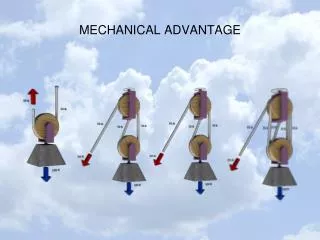
The ideal mechanical advantage of a pulley system • is equal to the number of sections of rope that • support the object. (Don’t include the rope on • which you pull downward, because it does not • support the object.)