### Enhancing Student Engagement Through Effective Questioning Techniques ###
This guide explores essential questioning strategies designed to deepen student understanding and foster meaningful discussions. By recognizing effective questions and using engaging formative assessment activities, educators can enhance classroom interactions. Learn how to differentiate between closed and open-ended questions, refine questioning techniques, and utilize reflection to promote cognitive engagement. Emphasize the importance of waiting time and the cognitive level of questions to support student responses. This resource is aimed at improving questioning practices for better educational outcomes. ###

### Enhancing Student Engagement Through Effective Questioning Techniques ###
E N D
Presentation Transcript
Jenny Ray Renee’ Yates QualityQuestioning Jenny.ray@education.ky.gov Renee.yates2@education.ky.gov October 27, 2012
Targets • Recognize effective questions to use with students and facilitate discussions & provide feedback to move students forward. • Promote questioning with students using engaging techniques and formative assessment activities.
You may remember…. • Economics
Handout 1 Mostly 4’s - Nice Mostly 2-3’s - See suggestions Mostly 1’s – See me at the break!
Handout 1 Side 2
Discuss with a partner… • What are some areas of questioning you do well? • What are some areas of questioning you can improve on based on the survey results?
350 a day x 180 days = 63,000 (Only 5% or 17 would be considered higher level questions) 63,000 x 10 = 630,000 63,000 x 20 = 1,260,000 63,000 x 30 = 1,890,000 Leven and Long, 1981
Habits Are Hard to Break A teacher with 20 years of experience will have asked something like 1.2 million questions in her career. And when you’ve done something the same way, over a million times, it’s quite difficult to start doing it another way. Wiliam (2003)
Betsy’s quotes • Ruby Payne… • Shirley Clarke – • Most questions are answered in less than 1 second • We want to push students to be the ones doing the thinking.
This is where we will do a card sort…into two piles. • Lead them through a discussion about what characteristics differentiate your two piles. • Use the next slide to help generate characteristics • Then the closed/open slide to solidify their understanding.
For example… Closed/Open Questions • To which fact family does the fact 3 x 4 = 12 belong? • Describe the picture below by using a mathematical equation. x x x x x x x x x x x x
OPEN CLOSED vs • They give you facts. • They are easy to answer. • They are quick to answer. • They keep control of the conversation with the questioner. • Is likely to receive a long answer. • They ask the respondent to think and reflect. • They will give you opinionsand • feelings. • They hand control of the conversation to the respondent.
Creating Open Questions • Turning around a question • Asking for similarities and differences • Replacing a number/word with a blank • Asking for a number sentence • Changing the question/extend the answer
Turning Around a Question What is half of 20? • Instead Try: 10 is a fraction of a number. What could the fraction and the number be? What is the hypotenuse of a right triangle if the legs are 3 units and 4 units? • Instead Try: One side of a right triangle is 5 units long. What could the other side lengths be?
Asking for Similarities/Differences • How is a square similar to a rectangle? How is it different? • How are the square root of 2 and the square root of 5 the same? Different?
Replacing a Number with a Blank • Find the perimeter of a rectangle with a length of 31 and a width of 18. Instead Try: Choose a number for the length of a rectangle. Now choose a number for the width of a rectangle. What is the area of this rectangle?
Asking for a Number Sentence • Create a math sentence with the numbers 3 and 4 along with the word “more” • Create a math sentence that includes the words “linear” and “increasing” as well as the numbers 4 and 9.
Extending the Question Handout 2 At the end of a student answer ask: • How do you know? Or… • What could… • What might… • Do you agree…why or why not? • When would…
Table Talk-Process Time • What will you try?
What are the implications of asking good questions in a classroom?(Discuss with your shoulder partner.) Reflection Time…..
Other Considerations… • Wait Time (3 seconds) • Cognitive Level of Questions • Recall • Use • Create • Questions need to focus on big ideas or curricular goals • Be sure to provide just the right amount of ambiguity
How do we expect students to answer questions? • http://www.youtube.com/watch?v=Boxsh_onY5E
Nice quote: • “Quality questions create a quality life. Successful people (teachers) ask better questions, and as a result, they get better answers.”Anthony Robbins
A good question is framed in such a way that a variety of responses or approaches are possible.
Connect to TPGES card… MY FAVORITE NO… Each person at table select a different section of the CHETL card. Read over your section.
TPGES slide • 3b Questioning from TPGES
My Favorite No…Formative Assessment Strategy • While watching the video clip, check which statement you observe from the lesson. prepared to share at the end. • https://www.teachingchannel.org/videos/my-favorite-no?fd=0
This morning we… • Effective Questioning • Self assessment • Cognitive level of questions • Closed vs Open Questions • My Favorite No
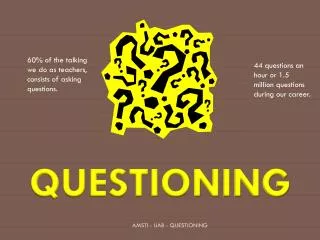
Questioning • On Average, a teacher asks 400 questions a day (one third of their time) • Most of the questions are answered in less than one second (Hastings, 2003) • 60% recall facts and 20% are procedural (Hattie, 2012) • IRE structure is dominate (Initiate – respond –evaluate) • Most answers are right or wrong
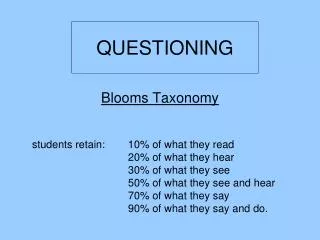
Students asking Questions • Teachers take up to two-thirds of the classroom talk time. Students are “talk-deprived” (Alvermann et al., 1996) • Student discussion increase retention as much as 50%. (Sousa, 2001)
Renee’ Yates and Jenny Ray Regional Mathematics Content Specialists Kentucky Department of Education Office of Next Generation Learners • www.ReneeYates2math.com • www.JennyRay.net Thank you for your participation today!