Emotional Development
This overview explores the emotional development of infants, focusing on their expressions, self-regulation, and temperament. It covers basic emotional responses such as crying, anger, and separation anxiety, highlighting the difference between endogenous and exogenous behaviors. It also discusses the role of imitation in perceiving emotions and the significance of temperament in shaping a child's responses to events. Understanding these early emotional expressions helps caregivers support infant development and foster healthy emotional growth.

Emotional Development
E N D
Presentation Transcript
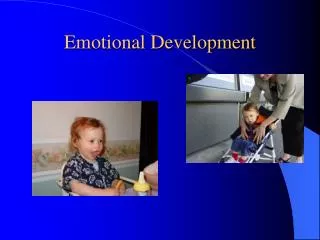
Emotional Development • Emotions: complex set of behaviors produced in response to some external or internal event. • Self-regulation: ability to calm oneself when distressed or excited
Early Emotional Expressions • Smiling • Endogenous • Exogenous
Crying • Basic • Anger • Pain • Colic http://video.google.com/videoplay?docid=1290105013215957966&q=infant+crying&total=11884&start=0&num=10&so=0&type=search&plindex=5
Other Emotional Expressions • Anger • Fear • Separation Anxiety: • http://video.google.com/videoplay?docid=1175151981122766441&q=social+referencing&total=175&start=0&num=10&so=0&type=search&plindex=0 • Stranger Anxiety: http://video.google.com/videoplay?docid=11751519 • 81122766441&q=social+referencing&total=175&start=0&num=10&so=0&type=search&plindex=0
Perceiving Emotion • Imitating Emotions http://video.google.com/videoplay?docid=-1851846288521201892&q=newborn+imitation&total=5&start=0&num=10&so=0&type=search&plindex=1
Temperament • Tendencies to respond in predictable ways to events. • Buss & Plomin, 1984 • Emotionality, activity, sociability • Kagan, 1989 • Behavioral Inhibition: tendency to be extremely shy and restrained in response to unfamiliar people and situations.
Thomas & Chess • 9 Dimensions of Infant Behavior • Typical Mood • Regularity of Biological Functions • Tendency to approach or withdraw • Intensity of emotional reactions • Adaptability • Activity level • Distractibility • Attention span • Threshold of responsiveness
Three Categories of Infant Temperament • Easy (40%) • Difficult (20%) • Slow-to-warm-up (15%) • Goodness of fit: extent to which child’s temperament is compatible with demands and expectations of social world to which child must adapt.
Other Aspects of Emotional Development • Social Referencing: looking to another individual for emotional cues in interpreting a strange/ambiguous event. • Video: http://video.google.com/videoplay?docid=1175151981122766441&q=social+referencing&total=175&start=0&num=10&so=0&type=search&plindex=0 • Complex emotions