Globalization, Eco-Footprints, and Unsustainable Nation Entanglement: Insights from William E. Rees
Join Dr. William E. Rees, Professor at UBC, as he explores the concepts from his influential book, "Our Ecological Footprint," co-authored with Dr. Mathis Wackernagel. This presentation discusses how globalization and trade have led to the unsustainable entanglement of nations, accelerating ecological degradation and increasing the risk of international conflicts. By employing ecological footprint analysis (EFA), Dr. Rees reveals that high-income countries are depleting the biocapacities of poorer nations, resulting in a precarious state of overshoot and vulnerability to global changes.

Globalization, Eco-Footprints, and Unsustainable Nation Entanglement: Insights from William E. Rees
E N D
Presentation Transcript
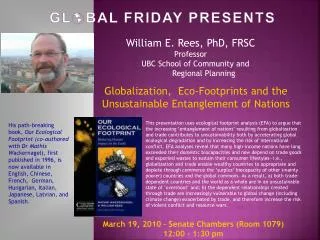
GLBAL FRIDAY PRESENTS William E. Rees, PhD, FRSC Professor UBC School of Community and Regional Planning Globalization, Eco-Footprints and the Unsustainable Entanglement of Nations His path-breaking book, Our Ecological Footprint (co-authored with Dr Mathis Wackernagel), first published in 1996, is now available in English, Chinese, French, German, Hungarian, Italian, Japanese, Latvian, and Spanish. This presentation uses ecological footprint analysis (EFA) to argue that the increasing ‘entanglement of nations’ resulting from globalization and trade contributes to unsustainability both by accelerating global ecological degradation and by increasing the risk of international conflict. EFA analyses reveal that many high-income nations have long exceeded their domestic biocapacities and now depend on trade goods and exported wastes to sustain their consumer lifestyles—i.e., globalization and trade enable wealthy countries to appropriate and deplete through commerce the ‘surplus’ biocapacity of other (mainly poorer) countries and the global commons. As a result, a) both trade-dependent countries and the world as a whole are in an unsustainable state of ‘overshoot’ and; b) the dependent relationships created through trade are increasingly vulnerable to global change (including climate change) exacerbated by trade, and therefore increase the risk of violent conflict and resource wars. March 19, 2010 – Senate Chambers (Room 1079) 12:00 – 1:30 pm