Influence of Knee Joint Angular Velocity on Muscle Activity and Torque
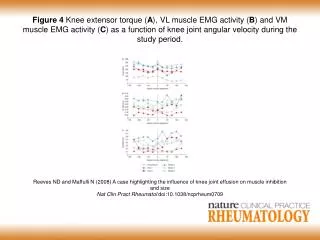
This study examines the relationship between knee extensor torque, vastus lateralis (VL) muscle EMG activity, and vastus medialis (VM) muscle EMG activity as a function of knee joint angular velocity. Key findings highlight the impact of knee joint effusion on muscle inhibition and muscle size, emphasizing how fluid accumulation affects muscle function and performance. The research offers insights into rehabilitation approaches for conditions affecting the knee joint and enhances our understanding of muscle dynamics during movement.

Influence of Knee Joint Angular Velocity on Muscle Activity and Torque
E N D
Presentation Transcript
Figure 4 Knee extensor torque (A), VL muscle EMG activity (B) and VM muscle EMG activity (C) as a function of knee joint angular velocity during the study period. Reeves ND and Maffulli N(2008) A case highlighting the influence of knee joint effusion on muscle inhibition and size Nat Clin Pract Rheumatol doi:10.1038/ncprheum0709