Understanding Activation Energy and Its Impact on Reaction Rates
Activation energy is the minimum energy required for a chemical reaction to take place, typically derived from the kinetic energy of colliding particles. Different reactions require varying activation energies, with some initiating spontaneously when reactants come into contact, while others, like propane combustion, require an initial energy input. Reaction rates can be measured through the disappearance of reactants or the appearance of products, and several factors such as temperature, concentration, pressure, and the presence of catalysts can significantly affect these rates. Understanding these concepts is crucial for mastering chemical kinetics.

Understanding Activation Energy and Its Impact on Reaction Rates
E N D
Presentation Transcript
Reaction Rates Section 6.3
Activation Energy • There is a certain amount of energy needed in order for a chemical reaction to occur • The energy comes from the kinetic energy of the moving particles • If the collide with enough force to overcome the potential energy in the chemical bonds, the reaction starts • The energy needed when the particles collide is called Activation energy
Amount of Activation Energy • Each reaction requires a different amount of activation energy • Some reactions, like potassium and water, will occur when two substances are put in contact with one another • Other reactions, like the combustion of propane, need some energy to get started and then will continue without the added energy
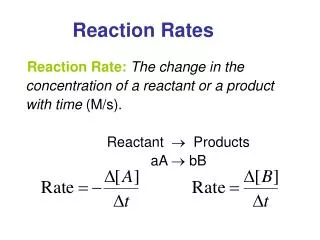
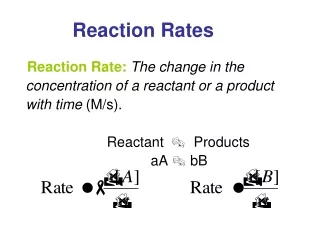
Reaction Rates • All reactions occur at different rates • There are two different methods for measuring the rate of a reaction • Disappearance of the reactants • Appearance of the products • In each of these methods the rate is determined by how fast these things occur
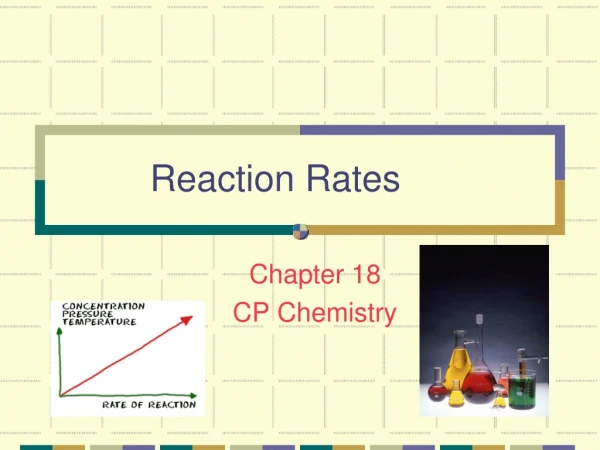
Effecting Rates of Reaction • Increasing temperature increases the rate of reaction • Increasing concentration increases the rate of reaction • Increasing pressure (decreasing the amount of space for the reaction to occur) increases the rate of reaction • Adding a catalyst increases the rate of a reaction
Catalysts • Make sure to find out all you can about catalysts