Trigonometry Review
This document provides a thorough review of fundamental trigonometric functions and their derivatives. Key calculations include sin(p/4), cos(p/4), tan(p/4), csc(2p/3), sec(2p/3), and their respective derivatives. It also covers the application of the chain rule and product rule in finding derivatives of composite and product functions involving sin, cos, and tan. Additionally, explore concepts like acceleration and the slope of tangent lines for various trigonometric functions. A valuable resource for students looking to reinforce their understanding of trigonometry.

Trigonometry Review
E N D
Presentation Transcript
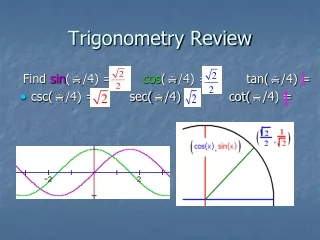
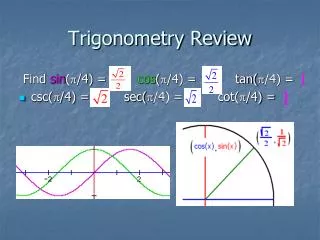
Trigonometry Review Find sin(p/4) = cos(p/4) = tan(p/4) = • csc(p/4) = sec(p/4) = cot(p/4) =
Evaluate tan(p/4) • Root 2 • 2 • Root 2 /2 • 2 / Root 2 • 1
Trigonometry Review sin(2p/3) = cos(2p/3) = tan(2p/3) = • csc(2p/3) = sec(2p/3) = cot(2p/3) =
Evaluate sec(2p/3) • -1 • -2 • -3 • Root(3) • 2 / Root(3)
Trig. Derivatives sin’(x) = cos(x) cos’(x) = - sin(x)
Trig. Derivatives sin’(x) = cos(x) sin’(x) =
sin’(x) = . sin’(x) = sin’(x) =
Rule 4 says . • 0 • 0.5 • 1 • 1.5
Rule 5 says . • 0 • 0.5 • 1 • 1.5
sin’(x) = . sin’(x) = sin’(x) =
Trig. Derivatives sin’(x) = cos(x) cos’(x) = - sin(x)
If y = sin(x) + 2x2, find dy/dx • - cos(x) + 4x • cos(x) + 4 • cos(x) + 4x
Trig. Derivatives • sin’(x) = cos(x) cos’(x) = - sin(x) • A) sin’(0) = cos(0) = 1 • B) sin’(p/4) = cos(p/4) = 0.707 • C) sin’(-p/3) = cos(-p/3) = 0.5
x= 0, 2p/3, - 3p/4 • cos’(x) = - sin(x) • A) cos’(0) = -sin (0) = 0 • B) cos’(-3p/4) = -sin(5p/4) = 0.707 • C) cos’(2p/3) = -sin(2p/3) = - 0.866
Evaluate cos’(p/2) • -1 • -.707 • 1 • 0.707
Evaluate sin’(p/3) • - 0.5 • 0.5 • 0.707 • 0.866
Trig. Derivatives • sin’(x) = cos(x) cos’(x) = - sin(x) • tan’(x) = sec2(x) cot’(x) = - csc2(x) • sec’(x) = sec(x)tan(x) csc’(x) = -csc(x)cot(x)
Trig. Derivatives • Theorem tan’(x) = sec2(x) • Proof : tan’(x) = [sin(x)/cos(x)]’
Trig. Derivatives • Theorem tan’(x) = sec2(x) • tan’(p/4) =
Trig. Derivatives • Theorem tan’(x) = sec2(x) • tan’(p/4) = sec2(p/4) = 2 while tan(p/4) = • 1
Trig. Derivatives • Theorem cot’(x) = - csc2(x) • Proof : cot’(x) = [cos(x)/sin(x)]’
Trig. Derivatives • Theorem sec’(x) = sec(x)tan(x) • Proof : sec’(x) = [1/cos(x)]’
Trig. Derivatives • Theorem csc’(x) = - csc(x)cot(x) • Proof : csc’(x) = [1/sin(x)]’
Trig. Derivatives • sin’(x) = cos(x) cos’(x) = - sin(x) • tan’(x) = sec2(x) cot’(x) = - csc2(x) • sec’(x) = sec(x)tan(x) csc’(x) = - csc(x)cot(x)
If y = tan(x) sec(x) find thevelocity and y’(p/3) sec’(x) = sec(x)tan(x) tan’(x) = sec2(x) y ’ = tan(x)sec(x)tan(x) + sec(x)sec2(x) y’=sec(x)[sec2 (x)-1] + sec3(x)=2sec3(x)-sec(x) y’(p/3) = 2sec3(p/3)-sec(p/3) = sin2x+cos2x=1 dividing by cos2(x) tan2 (x)+1=sec2 (x)
If y = tan(x) cos(x) find theacceleration and y’’(p/3) y’ = cos(x) y’’ = -sin(x) y’’(p/3)=
If y = tan(x) + cos(x) find theinitial acceleration, y’’(0) tan’(x) = sec2(x) sec’(x) = sec(x)tan(x) y’ = sec(x)sec(x) - sin(x) y’’ = sec(x) sec(x)tan(x) + sec(x) sec(x)tan(x) - cos(x) = 2 sec2(x) tan(x) – cos(x) y’’(0) = 2 * 1 * 0 - . . . . . .
y” = 2 sec2(x) tan(x) – cos(x)y”(0) = • -1.0 • 0.1
If y = sec(x), find the acceleration, y’’(0) using the product rule on sec’(x). • 1.0 • 0.1
Find the slope of the tangent line to y = x + sin(x) when x = 0 • 2.0 • 0.1
Write the equation of the line tangent to y = x + sin(x) when x = 0 • y = 2x + 1 • y = 2x + 0.5 • y = 2x