Comprehensive Trigonometry Review: Radians, Special Angles, and Graphs
This review covers essential trigonometry concepts including radians and their conversion to and from degrees. Explore special angles and their corresponding coordinates on the unit circle, along with definitions of trigonometric functions and their signs across different quadrants. Dive into graphing fundamental trigonometric functions like sine and cosine, examining period, amplitude, phase shifts, and graph transformations. Learn important trigonometric identities and strategies for solving equations using algebra and inverse functions to fully master the subject.

Comprehensive Trigonometry Review: Radians, Special Angles, and Graphs
E N D
Presentation Transcript
radians, so radians To convert from degrees to radians, multiply by To convert from radians to degrees, multiply by Angle Measurement
r=1 Special Angles
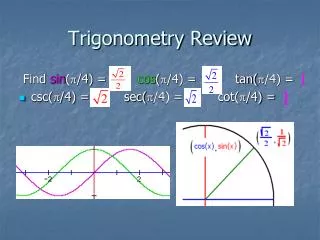
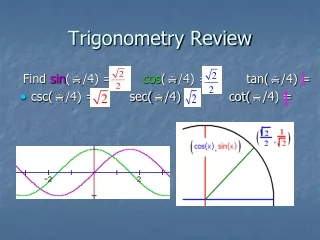
π/2 π/3 3π/4 2π/3 π/4 5π/6 π/6 π 0 3π/2 r=1 Special Angles - Unit Circle Coordinates
r (x,y) Trig Functions - Definitions
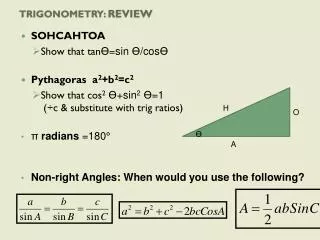
hyp opp adj Trig Functions - Definitions
Trig Functions Signs by quadrants sin, csc positive all functions positive tan, cot positive cos, sec positive
example: Special Angles - Triangles
r=1 Special Angles - Unit Circle
(0,1) r = 1 (-1,0) (1,0) (0,-1) Use the unit circle points (1,0), (0,1), (-1,0) and (0,-1) or look at the graphs for the trig functions example: Special Angles For the angles
y = sin x 1 -π/2 π/2 π 3π/2 2π -1 Period is and amplitude is 1. Graphing Trigonometry Functions Basic Graphs
y = cos x 1 -π/2 π/2 π 3π/2 2π -1 Period is and amplitude is 1. Graphing Trigonometry Functions Basic Graphs
Using the graph for Special Angles and Graphs
y = a sin x a -π/2 π/2 π 3π/2 2π -a Period is and amplitude is a. Graphing Trig Functions Amplitude Change y= a sin x stretches or compresses the graph vertically
y = sin(x -b) 1 b 2π+b -1 Period is and amplitude is 1. Graphing Trig Functions Phase Shift y = sin(x -b) slides graph right by bunits
y = sin(x +b) 1 -1 -b 2π -b Period is and amplitude is 1. Graphing Trig Functions Phase Shift y = sin(x + b) slides graph left by bunits
1 2π/c -1 Period is and amplitude is 1. Graphing Trig Functions Period Change y = sin cx stretches or compresses the graph horizontally
Trig Identities Reciprocal Quotient
Trig Identities Pythagorean
Trig Identities Double Angle
TrigIdentities Sum and difference
is equivalent to is equivalent to Inverse Trig Functions
example: if and since in quadrants I and II Solving Trig Equations Use algebra, then inverse trig functions or knowledge of special angles to solve.