
Knowledge
E N D
Presentation Transcript
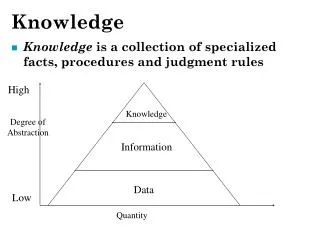
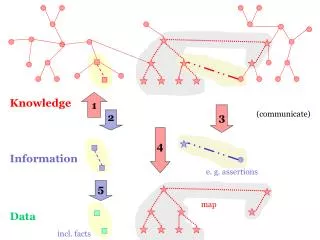
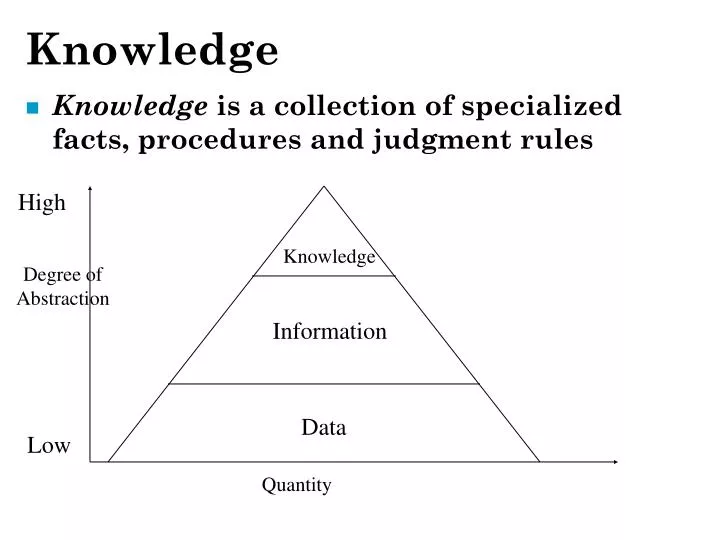
Knowledge • Knowledge is a collection of specialized facts, procedures and judgment rules High Knowledge Degree of Abstraction Information Data Low Quantity
Knowledge Sources • Documented (books, manuals, etc.) • Undocumented (in people's minds) • From people, from machines • Knowledge Acquisition from Databases • Knowledge Acquisition Via the Internet
Knowledge Levels • Shallow knowledge (surface) • Deep knowledge • Can implement a computerized representation that is deeper than shallow knowledge • Special knowledge representation methods (semantic networks and frames) to allow the implementation of deeper-level reasoning (abstraction and analogy): important expert activity • Represent objects and processes of the domain of expertise at this level • Relationships among objects are important
Major Categories of Knowledge • Declarative Knowledge • Procedural Knowledge • Metaknowledge
Declarative Knowledge Descriptive Representation of Knowledge • Expressed in a factual statement • Shallow • Important in the initial stage of knowledge acquisition
Procedural Knowledge • Considers the manner in which things work under different sets of circumstances • Includes step-by-step sequences and how-to types of instructions • May also include explanations • Involves automatic response to stimuli • May tell how to use declarative knowledge and how to make inferences
Descriptive knowledge relates to a specific object. Includes information about the meaning, roles, environment, resources, activities, associations and outcomes of the object • Procedural knowledge relates to the procedures employed in the problem-solving process
Metaknowledge Knowledge about Knowledge In ES, Metaknowledge refers to knowledge about the operation of knowledge-based systems Its reasoning capabilities
Knowledge Modeling • The knowledge model views knowledge acquisition as the construction of a model of problem-solving behavior-- a model in terms of knowledge instead of representations • Can reuse models across applications
Knowledge Representation • Logical representation – first order predicate calculus, Prolog, declarative knowledge • Procedural representation – a set of instructions for solving a problem, such as a production system • Network representation – knowledge is in a graph structure, such as conceptual dependency and conceptual graphs we will study in this chapter • Structured representation – an extension of networks, such as scripts or frames we will study in this chapter
Group Work • What type of knowledge representation would be appropriate to contain a rules to generate the following sequences
Group Work • What type of knowledge representation would be appropriate to solve “analogy” problems?
Knowledge Representation Once acquired, knowledge must be organized for use
Introduction • A good knowledge representation naturally represents the problem domain • An unintelligible knowledge representation is wrong • Most artificial intelligence systems consist of: • Knowledge Base • Inference Mechanism (Engine)
Knowledge Base • Forms the system's intelligence source • Inference mechanism uses to reason and draw conclusions • Inference mechanism: Examines the knowledge base to answer questions, solve problems or make decisions within the domain
Many knowledge representation schemes • Can be programmed and stored in memory • Are designed for use in reasoning • Major knowledge representation schemas: • Production rules • Frames
Representation in Logic andOther Schemas • General form of any logical process • Inputs (Premises) • Premises used by the logical process to create the output, consisting of conclusions (inferences) • Facts known true can be used to derive new facts that are true
Symbolic logic: System of rules and procedures that permits the drawing of inferences from various premises • Basic Forms of Computational Logic • Propositional logic (or propositional calculus) • Predicate logic (or predicate calculus)
Propositional Logic • A proposition is a statement that is either true or false • Once known, it becomes a premise that can be used to derive new propositions or inferences • Rules are used to determine the truth (T) or falsity (F) of the new proposition
Symbols represent propositions, premises or conclusions Statement: A = The mail carrier comes Monday through Friday. Statement: B = Today is Sunday. Conclusion: C = The mail carrier will not come today. • Propositional logic: limited in representing real-world knowledge
Predicate Calculus • Predicate logic breaks a statement down into component parts, an object, object characteristic or some object assertion • Predicate calculus uses variables and functions of variables in a symbolic logic statement • Predicate calculus is the basis for Prolog (PROgramming in LOGic) • Prolog Statement Examples • comes_on(mail_carrier, monday). • likes(jay, chocolate). (Note - the period “.” is part of the statement)
Lists Written Series of Related Items • Normally used to represent hierarchical knowledge where objects are grouped, categorized or graded according to • Rank or • Relationship
Decision Tables(Induction Table) Knowledge Organized in a Spreadsheet Format • Attribute List • Conclusion List • Different attribute configurations are matched against the conclusion
Decision Trees • Related to tables • Similar to decision trees in decision theory • Can simplify the knowledge acquisition process • Knowledge diagramming - very natural
O-A-V Triplet • Objects, Attributes and Values • O-A-V Triplet • Objects may be physical or conceptual • Attributes are the characteristics of the objects • Values are specific measures of the attributes
Default Logic • Deals with uncertainties • Incomplete information
Knowledge Maps • Visual representation • Cognitive maps
Semantic Networks • By following links, simple questions can be answered • Studies with human recall supported this model • Semantics nets were introduced by Quilian in the late 1960s for representing knowledge as a network of associations
Semantic Networks • Graphic Depiction of Knowledge • Nodes and Links Showing Hierarchical Relationships Between Objects • Nodes: Objects • Arcs: Relationships • is-a • has-a
Semantic networks can show inheritance • Semantic Nets - visual representation of relationships • Can be combined with other representation methods
Semantic Network Example Human Being Is a Boy Is a Is a Needs Goes to Woman Joe School Is a Food Has a child Kay
Conceptual Graphs • Graph Structure • Finite, connected, bipartite • Arcs are not labeled • Conceptual relation nodes are introduced between concepts • The bipartite nature of the graph means concepts can only link to conceptual relations and vice versa • In drawings, concepts are shown in boxes and conceptual relations in ellipses • Concepts may be concrete (dog, child, etc.) or abstract (love, beauty, etc.)
Arity of Relations • Examples of 1-ary, 2-ary, and 3-ary relations
Graph of a Sentence • “Mary gave John the book” • As in conceptual dependency, the verb plays a central role in the structure • The verb “give” in this sentence has an agent, an object, and a recipient
Group Work • What does the following conceptual graph represent
Types and Individuals • In the first case, the type is dog and the individual is “emma” • A specific but unnamed dog is given a unique number (#) • An alternative representation is to use a dog specified by a # and add a conceptual relation for a name
Three Names • “Her name was McGill and she called herself Lil, but everyone knew her as Nancy” (song lyric) • Who was the artist? What was the name of the song?
Itchy Dog • What is the English sentence for this structure? • If the same, unspecified individual is present in two or more nodes, a variable can be introduced that may eventually be bound to the same value
Type Lattice • Concepts often form a lattice of types, such as a class golden retriever a type of dog, a type of carnivore, a type of animal, and so forth • is a supertype of all types, is the absent type • Answering queries about a pair of concepts may involve finding the minimum common supertype
Generalization and Specialization • A concept node can be replaced with a restriction
Join of Concepts • If two graphs contain an identical node, they can be joined together by having only one copy of the identical node • Join is a form of restriction since the resultant graph is more specific than the original graphs
Simplification • A join may result in duplicate information • The simply operation allows the removal of duplication information
Inheritance • Inheritance is a form of generalization • Generalization does not guarantee that the resultant graph is true even if the original graphs are true
Propositional Nodes • “Tom believes that Jane likes pizza” • The verb believes takes a propositional node as its object
“There are no pink dogs” • In some cases a propositional node may stand alone, as seen here: • This is similar to modal logics that introduce a level of believability, such as necessary, probably, possible, or other levels, such as negative shown here
Group Work • What does the following conceptual graph represent
Conceptual Graphs and Logic • Conceptual graphs are equivalent to predicate calculus in expressive power • Here is an algorithm to change a conceptual graph into a predicate calculus expression
Production Rules • Condition-Action Pairs • IF this condition (or premise or antecedent) occurs, • THEN some action (or result, or conclusion, or consequence) will (or should) occur • IF the stop light is red AND you have stopped, THEN a right turn is OK
Each production rule in a knowledge base represents an autonomous chunk of expertise • When combined and fed to the inference engine, the set of rules behaves synergistically • Rules can be viewed as a simulation of the cognitive behavior of human experts • Rules represent a model of actual human behavior