Download
1 / 9
90 likes | 222 Vues
This International Management course, instructed by Dr. Emeric Solymossy, explores key aspects of global business operations. The course utilizes Hodgetts & Luthans' textbook and offers various resources, including PowerPoint presentations, writing guides, and electronic materials. Office hours are held on Mondays and Wednesdays, and students can reach Dr. Solymossy via phone or email for questions and guidance. The course emphasizes diverse learning styles and evaluation methods, ensuring a comprehensive understanding of international management principles.

E N D
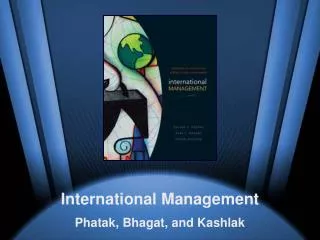
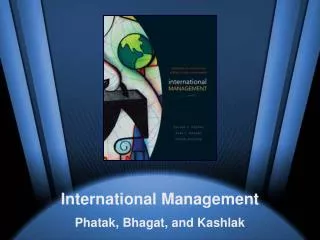
Mgt 485 International Management • Contact Information: • Dr. Emeric Solymossy • Pronounced: Shoi moshi aka: “Dr. E” • Availability / Accessibility • Office Hours: M & W: 10:00 am – 12:00 pm, 2:00 pm - 3:00 pm • or by appointment • Office phone: 309-762-9481 or 309-762-3999, xt249 • eMail:E-Solymossy@wiu.edu • Web site:http://www.cbt.wiu.edu/Emeric_Solymossy/ • PPTs & Notes:http://www.cbt.wiu.edu/Emeric_Solymossy/Mgt485PPTs.htm
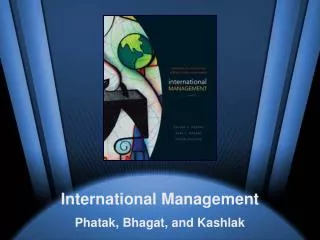
Course Introduction • Course Material • Syllabus • http://www.cbt.wiu.edu/Emeric_Solymossy/ • Text Book – International ManagementHodgetts & Luthans, 5/e • Power Point presentations: • Use of Internet / Electronic resources • Writing guides / writing lab • Elements of the Course
Course Introduction • Course Material • Syllabus • http://www.cbt.wiu.edu/Emeric_Solymossy/ • Text Book • Readings – Available in Electronic • Will be available on Line • Power Point presentations: • http://www.cbt.wiu.edu/Emeric_Solymossy/Mgt425ppts.htm • Writing guides / writing lab • Elements of the Course
Office Hours • Punctuality • Assignments • Tests (Make-up) • Eating and drinking in class • Talking in class • Pages, beepers, cell phones • Personal calculators, pda’s, etc.
Course Focii Social Manufactured Product Technological Service Economic Political
Bloom’s Taxonomy A Evaluation Judge value/ critique Synthesis Recombining parts: form new Analysis Breaking down into components Application Transfer of knowledge Comprehension Awareness of meaning C Knowledge Recall facts (memorization)
Preference for types of Learning • Linguistic (books, memory for names, words) • Logical – mathematical (curious, puzzles, logical) • Spatial (artistic, doodler, visual) • Bodily – Kinesthetic (physically active, tactile) • Musical (music elemental part of life) • Interpersonal (social, interactive) • Intrapersonal (independent)
Preferences for Modes of Learning • Type of information perceived • Sensory or intuitive • sights, sounds, physical sensations, or • memories, ideas, insights? • Modality for perceiving information • Visual or verbal • pictures, diagrams, graphs, demonstrations, or • verbal – sounds, written and spoken words and formulas? • Organization of information • Inductive or deductive • facts and observations are given; underlying principles inferred, or • principles are given; consequences and applications are deduced? • Preference for processing information • Actively or reflectively • through engagement in physical activity or discussion, or • through introspection? • Progression towards understanding • Sequentially or globally • in a logical progression of small, incremental steps, or • in large jumps, quantum leaps