Download
1 / 21
210 likes | 351 Vues
This resource delves into fundamental concepts related to the domain of functions and the properties of limits essential for calculus. It focuses on finding the domain of specific functions like f(x) = 1.3 - 2x, and highlights properties of limits involving direct substitution, scalar multiplication, sum and difference, product, and quotient. Additionally, it provides strategies for evaluating limits, including polynomial functions, rational functions, and trigonometric functions. Whether you're preparing for exams or honing your calculus skills, this guide is ideal for reinforcing your understanding of these critical mathematical ideas.

E N D
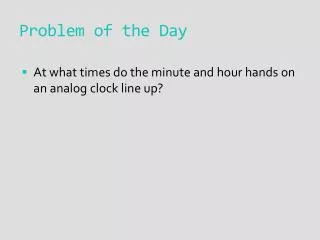
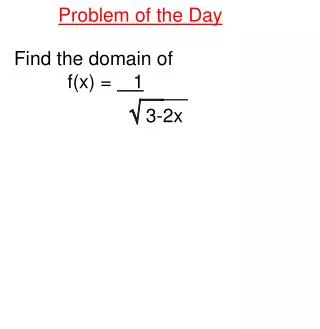
Find the domain of f(x) = 1 3-2x Problem of the Day
Find the domain of f(x) = 1 3-2x ( - , 3 ) 2 Problem of the Day
Properties of Limits Direct Substitution Let b and c be real numbers and n a positive integer - a) lim b = b (lim 4 = 4) b) lim x = c (lim x = 5) c) lim x = c (lim x = 9) x c x 5 x c x 5 2 2 2 x c x 3
x c x c x c x c Properties of Limits Let b and c be real numbers and n a positive integer and f and g functions with limits L and K respectively - scalar multiple lim [b f(x)] = bL sum or difference lim [f(x) +g(x)] = L + K product lim [f(x)g(x)] = LK quotient lim f(x) = L power lim [f(x)] = L g(x) K n n x c
lim (4x + 3) = x 2 Properties of Limits 2
2 lim 4x + lim 3 x 2 x 2 2 4 lim x + lim 3 x 2 x 2 2 4(2 ) + 3 Properties of Limits 2 lim (4x + 3) = x 2 19
x c Properties of Limits If p is a polynomial function and c is a real number then lim p(x) = p(c). If r is a rational function r(x) = p(x), c is a real number and q(c) = 0 then q(x) lim r(x) = r(c) = p(c) q(c) x c
Properties of Limits 2 lim x + x + 2 x 1 x + 1
Properties of Limits 2 2 lim x + x + 2 1 + 1 + 2 = x 1 x + 1 1 + 1 = 2
n n lim n = c x c Properties of Limits Let n be a positive integer. If n is odd and c is a real number or if n is even and c is > 0 then If f and g are functions with limits L and M then lim f(g(x)) = f(L) x c
x c x c x c x c x c x c Properties of Limits Trig Functions lim sin x = sin c lim cos x = cos c lim tan x = tan c lim cot x = cot c lim sec x = sec c lim csc x = csc c
lim (x cos x) = x Properties of Limits
Properties of Limits lim (x cos x) = x (lim x)(lim cos x) x x cos -
? ? ? How observant have you been? Can you draw the figure that is a composite of all the parts that you have been shown in the upper right hand corner of the screens? ? ? ? ? ? ?
Strategy for Finding Limits x c x c 2 (x - 1)(x + x + 1) 3 lim x - 1 = x 1 x - 1 x - 1 1. Cancellation and direct substitution If f(x) = g(x) for all x = c and c is real (functions that agree at all but one point) Then lim f(x) = lim g(x) 2 = x + x + 1 = 3
Strategy for Finding Limits lim x + 1 - 1 x 0 x x + 1 - 1 ( ) ( x + 1 + 1 ) x x + 1 + 1 2. Rationalization and direct substitution (x + 1) - 1 = 1 x ( x + 1 + 1) 2
x c x c x c Strategy for Finding Limits g(x) 3. Squeeze Theorem f(x) h(x) If h(x) < f(x) < g(x) for all x in the open interval containing c, except possibly c, and lim h(x) = L = lim g(x) then lim f(x) exists and is L.
Strategy for Finding Limits 4. By definition ) ( lim sin x lim x = 1 = 1 x x 0 x 0 sin x lim 1 - cos x = 0 x x 0
Strategy for Finding Limits 5. Be creative! lim sin 4x x x 0 (as x approaches 0, y also approaches 0) (let 4x = y) 4 lim sin 4x 4 lim sin y = = 4(1) x 4 y x 0 y 0