Understanding Bayesian and Belief-Function Formalisms in Probability Theory
This text explores two powerful approaches to probability: Bayesian Formalism and Belief-Function Formalism, including the Dempster-Shafer theory. Bayesian Formalism calculates the probability of propositions based on evidence, while Belief-Function Formalism evaluates the likelihood that evidence supports a proposition without ruling out alternatives. Key concepts include Basic Probability Assignment (BPA) and how belief functions represent evidence in uncertain environments. Applications span various fields, such as auditing and medical diagnoses, highlighting their relevance in dealing with incomplete or unreliable information.

Understanding Bayesian and Belief-Function Formalisms in Probability Theory
E N D
Presentation Transcript
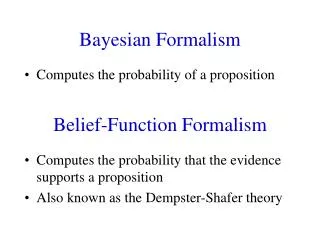
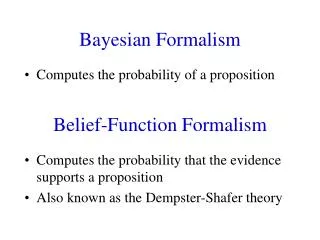
Bayesian Formalism Belief-Function Formalism • Computes the probability of a proposition • Computes the probability that the evidence supports a proposition • Also known as the Dempster-Shafer theory
Bayesian Formalism • There is an 90% chance that the department is following a procedure and 10% chance they are not. Belief-Function Formalism • We have a 90% reason to believe that the department is following procedure but no reason not to (0%).
Belief Function • Written as Bel(x) • Measures the likelihood that the evidence supports x. • Where x is a subset of of some set S that represents the range of possible choices. • For example let S be the set of possible causes for a disease.
Basic Probability Assignment (bpa) • The impact of each distinct piece of evidence on the subsets of S is represented as a function known as the bpa. • It is a generalization of the traditional probability density function. • For example…
The Belief Function • The Bel(x) is then the sum of the bpas of all the possible subsets of x which in tern is a subset of S. • The Bel(S) is always 1. • The Bel(Ø), the empty set, is always 0. • For example...
The Belief-Function Formalization ... • Provides a way to represent ignorance in ways that the Bayesian formalism can not. • Looks at questions of interest in a more indirect way. • Is in fact a generalization of the Bayesian formalization.
Uses • Auditing • Medical Diagnoses • Or any other sort of application where information is gathered from semi-reliable sources.