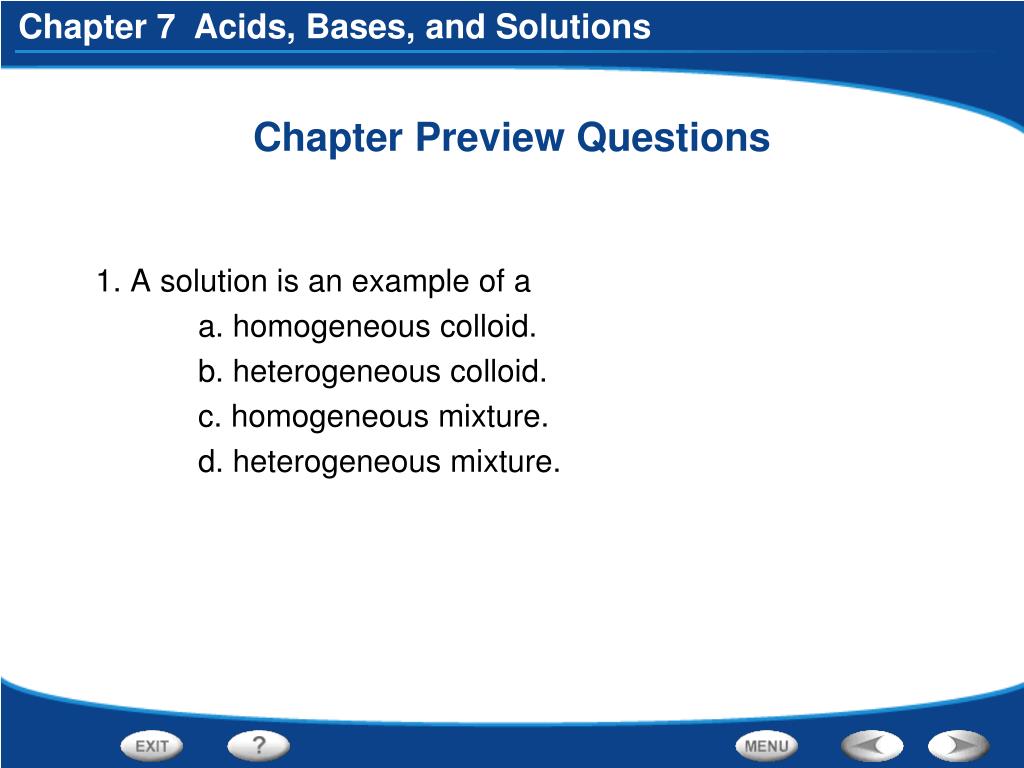
Chapter Preview Questions. 1. A solution is an example of a a. homogeneous colloid. b. heterogeneous colloid. c. homogeneous mixture. d. heterogeneous mixture. Chapter Preview Questions. 1. A solution is an example of a a. homogeneous colloid. b. heterogeneous colloid.
Une image / un lien ci-dessous est fourni (tel quel) pour télécharger la présentation
Politique de téléchargement : le contenu du site vous est fourni TEL QUEL pour votre information et votre usage personnel ; il ne peut être vendu, concédé sous licence ni partagé sur d’autres sites sans l’accord de son auteur.Le contenu vous est fourni TEL QUEL, pour votre information et votre usage personnel uniquement.Téléchargez la présentation en cliquant sur ce lien.Lors du téléchargement, si vous ne parvenez pas à télécharger une présentation, l’éditeur a peut-être supprimé le fichier de son serveur.Pendant le téléchargement, si vous ne parvenez pas à obtenir une présentation, le fichier a peut-être été supprimé par l’éditeur.
F I N
Plus de contenu associé
Transcription de la présentation
Chapter Preview Questions • 1. A solution is an example of a • a. homogeneous colloid. • b. heterogeneous colloid. • c. homogeneous mixture. • d. heterogeneous mixture.
Chapter Preview Questions • 1. A solution is an example of a • a. homogeneous colloid. • b. heterogeneous colloid. • c. homogeneous mixture. • d. heterogeneous mixture.
Chapter Preview Questions • 2. Magnesium sulfide and aluminum fluoride are • a. ionic compounds. • b. molecular compounds. • c. covalent electrons. • d. radioactive elements.
Chapter Preview Questions • 2. Magnesium sulfide and aluminum fluoride are • a. ionic compounds. • b. molecular compounds. • c. covalent electrons. • d. radioactive elements.
Chapter Preview Questions • 3. When dissolved in water, ionic compounds • a. conduct electricity. • b. make the water cloudy. • c. form double and triple bonds. • d. do not conduct electricity.
Chapter Preview Questions • 3. When dissolved in water, ionic compounds • a. conduct electricity. • b. make the water cloudy. • c. form double and triple bonds. • d. do not conduct electricity.
Chapter Preview Questions • 4. When dissolved in water, molecular compounds • a. conduct electricity. • b. make the water cloudy. • c. form double and triple bonds. • d. do not conduct electricity.
Chapter Preview Questions • 4. When dissolved in water, molecular compounds • a. conduct electricity. • b. make the water cloudy. • c. form double and triple bonds. • d. do not conduct electricity.
Suppose you dissolve a • teaspoon of salt in a glass of • water. Is it possible to recover • the salt from the water? • Explain. What are some characteristics of acids and bases?
Section 1: Understanding Solutions • Standard 8.5.d Students know physical processes including freezing and boiling, in which a material changes form with no chemical reaction.
Section 1: Understanding Solutions • What are the characteristics of a solution? • A solution has the same properties throughout. It contains solute particles (molecules or ions) that are too small to see. • Solutions: • Contain a solvent, which dissolves the other substances • Contain at least 1 solute, which is dissolved by the solvent • Dissolving one substance into another is a physical change. • The substances retain their original properties.
Section 1: Understanding Solutions • What are the characteristics of a colloid? • A colloid contains larger particles than a solution. The particles are still too small to be seen easily, but are large enough to scatter a light beam. • Examples: • milk • fog • mayonnaise • whipped cream
Section 1: Understanding Solutions • What are the characteristics of a suspension? • A suspension does not have the same properties throughout. It contains visible particles that are larger than the particles in solutions or colloids.
Particles in a Solution • When a solution forms, particles of the solvent surround and separate the particles of the solute.
Liquid water solution Effects of Solutes on Solvents • Solutes lower the freezing point and raise the boiling point of a solvent. Solute particles make it harder for water molecules to form crystals. Water molecules need more energy to boil when a solute is present. Solid (frozen) water
Section 1 Quick Quiz • How would a solute affect the boiling point of water? • The boiling point will be the same at the freezing point. • The water will not boil. • The water will boil at a lower temperature. • The water will boil at a higher temperature. • Answer: D – The water will boil at a higher temperature.
Section 1 Quick Quiz • When a solute is added to a solvent, the freezing point of the solution is • the same as the freezing point of the solute. • higher than the freezing point of either substance alone. • lower than the freezing point of either substance alone. • the same as the freezing point of the solvent. • Answer: C – lower than the freezing point of either substance alone.
Section 2: Concentration and Solubility • Standard 8.5.d Students know physical processes including freezing and boiling, in which a material changes form with no chemical reaction.
Concentration • How is concentration measured? • To measure concentration, you compare the amount of solute to the total amount of solution. • A concentrated solution has a lot of solute dissolved in a certain amount of solvent. • A dilute solution has only a little solute dissolved in a certain amount of solvent. • Concentration can be measured as the percent of solute in solution by volume or mass.
To calculate the concentration of a solution, compare the amount of solute to the amount of solution and multiply by 100 percent. For example, if a solution contains 10 grams of solute dissolved in 100 grams of solution, then its concentration can be reported as 10 percent. Calculating a Concentration
Practice Problem A solution contains 12 grams of solute dissolved in 36 grams of solution. What is the concentration of the solution? 33% Calculating a Concentration
Practice Problem A solution contains 15 ounces of solute dissolved in 60 ounces of solution. What is the concentration of the solution? 25% Calculating a Concentration
Practice Problem A solution contains 40 grams of solute dissolved in 200 grams of solution. What is the concentration of the solution? 20% Calculating a Concentration
Solubility • Solubility is a measure of how much solute can dissolve in a solvent at a given temperature. • If you can continue to dissolve more solute, you still have an unsaturated solution. • If no more solute will dissolve, you have a saturated solution.
Factors Affecting Solubility • What factors affect the solubility of a substance? • Factors that affect the solubility of a substance include pressure, the type of solvent, and temperature. • An increase in pressure increases the solubility of gases. • Ionic and polar compounds usually dissolve in polar solvents – “like dissolves like” • The solubility of most solids increases as temperature increases. • Gases become less soluble in a liquid when the temperature of the liquid goes up.
Temperature and Solubility • The solubility of the compound potassium nitrate (KNO3) varies in water at different temperatures.
KNO3 is least soluble at 0ºC. Reading Graphs: At which temperature shown in the graph is KNO3 least soluble in water? Temperature and Solubility
Section 2 Quick Quiz • When you add so much solute that no more dissolves, you have a • suspension. • unsaturated solution. • saturated solution. • neutralization. • Answer: C – saturated solution.
Section 2 Quick Quiz • What happens to the concentration of sugar in maple sap as the sap is boiled? • The concentration of sugar increases. • The concentration of sugar remains constant. • The concentration of sugar becomes 0%. • The concentration of sugar decreases. • Answer: A – The concentration of the sugar increases.
Section 2 Quick Quiz • If two unidentified solids of the same texture and color have different solubilities in 100 grams of water at 20°C, you could conclude that • they are the same substance. • they are different substances. • they have different melting points. • their solubilities will be the same if the water temperature is increased. • Answer: B – they are different substances
Section 2 Quick Quiz • A measure of how well a solute can dissolve in a solvent at a given temperature is that substance’s • concentration. • saturation point. • acidity. • solubility. • Answer: D - solubility
Section 2 Quick Quiz • What is one way to increase the solubility of sugar in water? • Heat the water. • Chill the water. • Increase the amount of sugar. • Decrease the amount of water. • Answer: A – Heat the water
Section 2 Quick Quiz • A beaker contains 120 grams of salt water solution. The salt water has 36 grams of salt dissolved in it. What is the concentration of the solution? • 36% • 30% • 72% • 24% • Answer: B – 30%
Properties of Acids and Bases • What are the properties of acids? • What are the properties of bases? • An acid tastes sour, reacts with metals and carbonates, and turns blue litmus paper red. • A base tastes bitter, feels slippery, and turns red litmus paper blue.
Properties of Acids and Bases • Litmus is an example of an indicator, a compound that changes color when in contact with an acid or a base.