The Vietnam War
Explore the complex history of Vietnam from its ancient struggles against foreign powers to its tumultuous relationship with the United States. This presentation covers key events, such as the rise of Ho Chi Minh, the Geneva Accords, and the controversial policies of the Diem regime. Dive into the escalation of U.S. involvement under Presidents Kennedy and Johnson, including the Gulf of Tonkin Resolution and Operation Rolling Thunder. Understand the effects of guerrilla tactics and the tragic loss of young American lives, alongside the voices and resistance of the Vietnamese people.

The Vietnam War
E N D
Presentation Transcript
The Vietnam War Mr. Grimaldi U.S. History
“Vietnam” - What comes to mind?
Quick background on Vietnam: Constant War • 2000 years of resistance to outsiders • China • Mid 1800’s French Colonialism in Indochina • WWII Japan • 1941 Birth of the Viet Minh
WWII ends, Ho Chi Minh tries to declare independence (modeled after U.S. Dec. of Ind.) • France goes to war to make Viet. their colony again • U.S. gives France $2.6 billion = contain communism Q: Look closely at H. C. M. Why was he considered a people’s leader?
9 years of war against France • 1954 French are defeated
Geneva Accords – July 1954 • Independence for Indochina
Agreement that Vietnam divided at 17th parallel • -North = Communists • -South = Democracy • 1956 – there would be an election to unify Vietnam
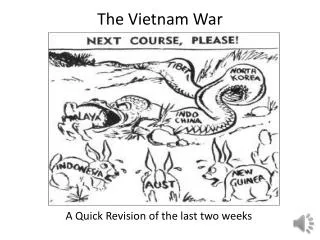
The United States Enters the War: • U.S. does not sign the treaty for election to unify because: • Domino Theory: if South Vietnam falls to Comm. = all of Southeast Asia follows
Diem Regime: • Unpopular Actions: • Imprisoned those who opposed him • Corruption, rigged elections, and nepotism • Catholic in a Buddhist country Q: How is Diem’s appearance different to Ho Chi Minh’s? Puppet Regime? Warning: next slide is graphic
Q: How would an American of the time interpret this image? Do you know of any instances of protest in recent times that mirror this event?
Kennedy Years: • Strengthen S. Vietnam Army with aid and training • 2. Pressure Diem’s decisions • - South Vietnam Army failed = money given to officials
The Overthrow of Diem: May 1963 = Buddhist start to protest June 1963 = Monk sets fire to himself Nov. 1963 = Diem is killed in a coup
Shortly after Diem’s assassination, tragedy strikes in the U.S. …
Lyndon Johnson 1963 - becomes president
Johnson’s War: - He kept Kennedy’s foreign policy team (“flexible response” strategy) - Needed strong anti-communism stance to win re-election
1964 Presidential Campaign: Johnson calls Goldwater an extremist / nuclear war http://www.youtube.com/watch?v=dDTBnsqxZ3k&feature=related
A. Gulf of Tonkin Resolution • North Viet. torpedo boats attack U.S. destroyers at Gulf of Tonkin • Aug. 1964: Gulf of Tonkin Resolution • Congress gives Johnson authority to “take all necessary measures…”
B. Operation Rolling Thunder • Feb. 1965 = Vietcong attack • U.S. military base (8 U.S. killed) • - U.S. bombed N. Vietnam (Nonstop for the next 3 years)
D. Fighting the War U.S. plan = break V.C. will to fight Success = not by land, but body count ( read Ho quote pg. 773)
1. The Air War • U.S. = intense bombing raids • Vietcong’s defense = 30K miles of tunnels
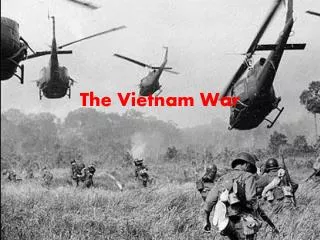
2. The Ground War • U.S. = Search + Destroy Missions • Suffocating envir. = swamps, heat, thick jungle, traps (B.B.) • Who’s who? • – Vietcong or S. Viet. farmer?
3. Guerilla Tactics of Vietcong • small bands of fighters use: • - ambush / hit + run • 2 Advantages • - knew the terrain • - support from the peasants • (food + shelter)
By 1967 = 14,000 US killed Aver. Age = 19 yrs old
Private First Class Phillip Wilson – Killed in action 12 days later.
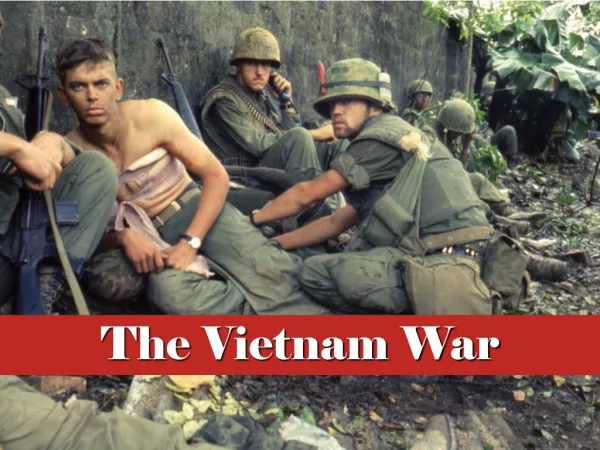
First-aid center, where wounded Marines were treated before being helped to air-evacuation points. (Life)