Understanding Social Pyramids: Hierarchies in Ancient and Medieval Societies
80 likes | 246 Vues
This lesson investigates social pyramids as frameworks to understand societal hierarchies from ancient Egypt and Japan to medieval Europe and France. We explore the classification of people, including pharaohs, priests, nobles, artisans, and peasants, to comprehend how social class shapes culture and power dynamics. The homework assignment involves creating a social class pyramid for an unspecified society, encouraging critical analysis and understanding of contemporary social structures, illustrated with the film "Slumdog Millionaire."


Understanding Social Pyramids: Hierarchies in Ancient and Medieval Societies
E N D
Presentation Transcript
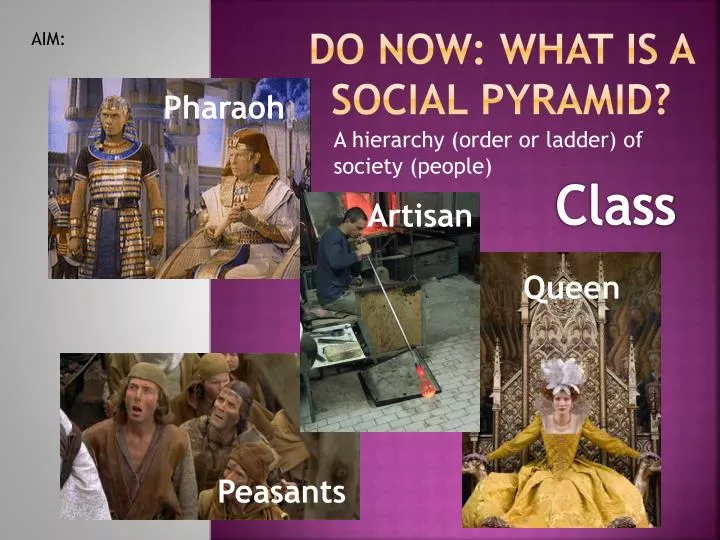
AIM: Do Now: What is a social pyramid? Pharaoh Class Artisan Queen A hierarchy (order or ladder) of society (people) Peasants
Pharaoh / King 1 EG Y P T 2 Priests / Nobles Soldiers 3 Scribes 4 5 Merchants 6 Farmers Slaves & Servants 7
Europe – Middle Ages F EUDA L I SM King Clergy 1 Nobles 2 Lords Knights Vassals 3 Peasants Serfs 4
Japan F EUDA L I S M Emperor (Figurehead) 1 2 Shogun Diamyos 3 Samurai 3 4 Peasants 5 Artisans 6 Merchants
Pre - 1789 FR A N C E 1st Estate Clergy 1 2nd Estate Nobility 2 3rd Estate 3 Everyone Else
Based upon the social pyramids reviewed, What does social class tell us about a society?
Homework: Complete a social class pyramid for the missing society not in today’s lesson. (hint: Slumdog Millionaire)