B. F. Skinner
280 likes | 1.9k Vues
Explore the groundbreaking work of B.F. Skinner, a prominent psychologist known for developing the theory of operant conditioning. His research demonstrated how behavior can be shaped through the use of rewards and punishments. Learn about important concepts such as reinforcement, punishment, and the Skinner Box experiment, where rats were conditioned to press levers for food rewards. Skinner's approach has significant implications for education, therapy, and understanding human and animal behavior. Discover how manipulating environmental factors can modify actions and thought processes.


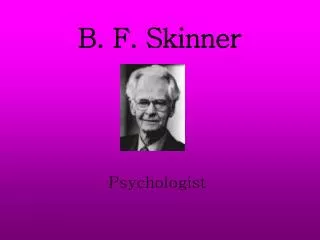
B. F. Skinner
E N D
Presentation Transcript
B. F. Skinner Radial Behaviorism
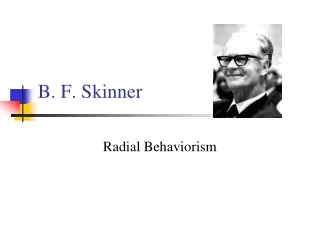
B.F. Skinner (1904-1990) • 1925: Hamilton College (NY): degree in English, no courses in psychology • Read about Pavlov’s and Watson’s experimental work • 1931: Ph.D. from Harvard
What did Skinner study? • Findings about the ways animals discover and learn things • Most actions (or behaviours) are basically learned, and can be unlearned and changed. • “Personality is the result of measuring outside forces. Thus, how we think and act can be modified by manipulating our environment.” (ABC’s of the Human Mind)
B. Operant Conditioning • Learning occurs through the presentation of rewards or punishments that influence voluntary behaviors.
Operant Conditioning • Changes in behavior is the outcome of an individual responding to occurrences in the environment (stimuli) • If the subject is correctly stimulated it will give the suitable response • When a stimulus-response pattern is reinforced (rewarded), the individual is conditioned to respond in a certain manner
Operant Conditioning – BF Skinner Law of effect (Thorndike) = if a behavior is followed by a better or more satisfying state of affairs, that behavior is more likely to occur again in the future. If a behavior is followed by a less satisfying state of affairs, that behavior is less likely to occur in the future.
Operating Conditioning Concepts Neutral operants: • responses from the environment that neither increase nor decrease the probability of a behavior being repeated. Reinforcer– anything that strengths a behavioral tendency • Positive reinforcement = getting something good • Negative reinforcement = taking away something aversive Punishment – anything that weakens a behavioral tendency • Can remove something positive (from positive to neutral) • Can give something negative (go from neutral to negative)
Skinner’s Work: • Skinner showed that by presenting animals (tested on pigeons and rats) or people withrewards & punishmentsyou could shape behavior. • Initially, to get a new behavior to appear & then be conditioned, you have to use shaping. • Shaping involves presenting a reinforcement for each successive approximation of a desired behavior. • E.g., if we want to shape lever pressing in rats, we would reinforce any behavior that even remotely resembles lever pressing.
Reinforcement-strengthens a behavior • 1. Positive Reinforcement: Strengthens a response by presenting something that is perceived as appetitive (pleasant) after a behavior is emitted. • E.g., a good grade received after studying for an exam, a food reward for pressing a lever, etc. • 2. Negative Reinforcement: strengthens a response by removing an aversive(negative) stimulus after a behavior is emitted. • E.g., people smoke more, to reduce aversive sensations associated with nicotine withdrawal.
Punishment: Two forms • 1. Positive Punishment - apply an aversive stimulus when an undesired behavior occurs. Must be immediate to be effective. • E.g., presenting lemon juice on a toddler’s tongue immediately after he or she bites. • 2. Negative Punishment - remove an appetitive (pleasant) stimulus when an undesired behavior occurs. • E.g., revoking a teenager’s driving privileges if they get a speeding ticket.
Skinner Box • Skinner created an apparatus that would present rewards to an organism (animals & humans!!) based on their behavioral responses. • He even had his daughter stay in the box for several experiments.
Skinner’s Rats • Rats were placed in metal cages with a number of levers. • The rats first accidentally pressed the levers in the cage, causing food or water to drop into a dish. • After repeating the action, the rats saw that they could receive food and water by pressing the lever. (Learned this behaviour) • So, when the rats were rewarded they were conditioned to repeat this positive action to continue being rewarded
Reinforcement • Continuous Reinforcement: Every time the rat does the appropriate behavior, he gets a pellet (food). • Fixed ratio schedule: If the rat presses the pedal three times, he gets a pellet…or five times, or twenty times, or x times. There is a fixed ratio between behaviors and reinforcers. • Fixed interval schedule: If the rat presses the bar at least once during a particular period of time, say 20 seconds, he gets a pellet. But whether he presses the bar once or a hundred times within that 20 seconds, he only receives one reinforcer. • Variable ratio schedule: You change the x each time. First it takes 3 presses to get a pellet, then 10, then 4, etc. • Variable interval schedule: You keep changing the time period. First 10 seconds, then 35, then 5, then 40.
Skinner’s Box and Rats • http://www.youtube.com/watch?v=PQtDTdDr8vs
What if the rat doesn’t get any more pellets? EXTINCTION: After a few futile attempts, the rat stops the bar-pressing behaviour
Skinner Box &Pigeons VIDEO • Skinner conditioned the pigeon’s to peck at a particular colored disk only when a light was on the cage and thus, getting rewarded by food and water. • This is based on Skinner’s theory of Operant Conditioning- behaviours are repeated if they are rewarded, and behaviours that are punished will be avoided • Light=Primary Reinforcer • Food &Water: Secondary Reinforcer
Importance of Skinner:Behaviour Modification Definition: adjusting the environment to change behavior by the use of timely reinforcement (positive and negative)
Behaviour Modification & Skinner • Believed that people could be persuaded to show “good” behaviour if they were properly reinforced for displaying them • If they displayed bad behaviour, the reward would be withheld.
Why is it important to the social sciences? • Knowing how people learn behaviour is a necessity to our society so that we can control and promote the good behaviour, which will benefit society as a whole. • The theory of operant-conditioning helps us to control the way humans learn behaviour and how society can be a great influence on behaviour • Helps us to understand how to improve behaviours (people with problem behaviours and criminal histories)