
HRM Trends and Strategies for High-Performance Workforce Optimization
E N D
Presentation Transcript
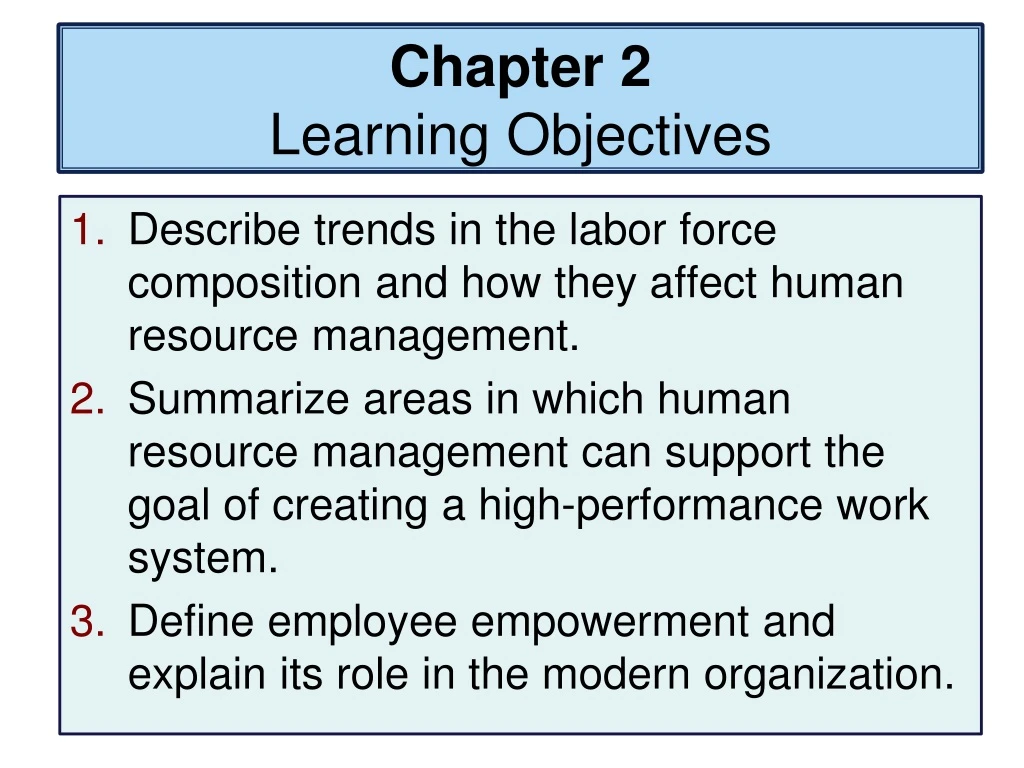
Chapter 2Learning Objectives Describe trends in the labor force composition and how they affect human resource management. Summarize areas in which human resource management can support the goal of creating a high-performance work system. Define employee empowerment and explain its role in the modern organization.
Chapter 2Learning Objectives (continued) Identify ways HR professionals can support organizational strategies for quality, growth, and efficiency. Summarize ways in which HRM can support organizations expanding internationally. Discuss how technological developments are affecting human resource management.
Chapter 2Learning Objectives (continued) Explain how the nature of the employment relationship is changing. Discuss how the need for flexibility affects human resource management.
Skill Deficiencies of the Workforce • Today, employers are looking for: • mathematical skills • verbal skills • interpersonal skills • computer skills The gap between skills needed and skills available has decreased companies ability to compete. They sometimes lack the capacity to upgrade technology, reorganize work, and empower employees.
High-Performance Work Systems • Organizations that have the best possible fit between their: • social system(people and how they interact); and • technical system(equipment and processes). • Key trends occurring in today’s high-performance work systems: • reliance on knowledge workers • the empowerment of employees to make decisions • the use of teamwork
Knowledge Workers • Employees whose contribution to the organization is specialized knowledge, such as: • knowledge of customers • knowledge of a process • knowledge of a profession • They are especially needed for jobs in: • health services • business services • social services • engineering • management