SlideServe
Menu
Préférences
© SlideServe · v2026

Optimizing Nutrition Strategies for VLBW Infants: Ensuring Adequate Amino Acids and Intralipids at Birth

portia-dennis avatar
1 diapositives · 162 Views · Nov 13, 2014

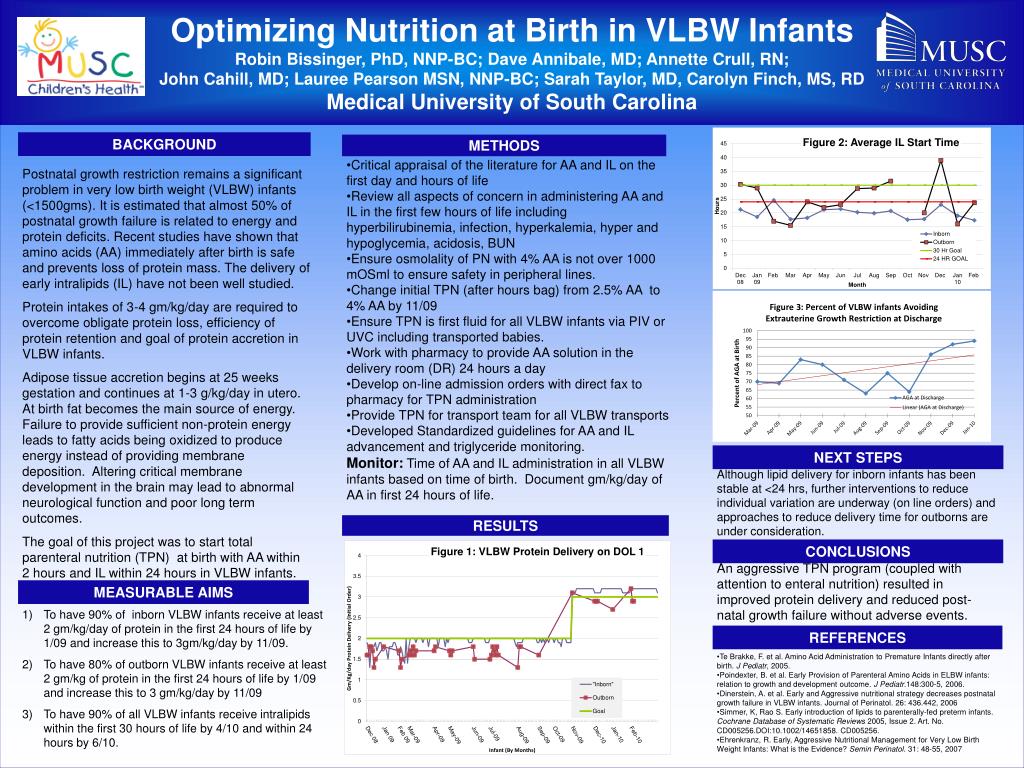
This study focuses on enhancing the nutritional management of very low birth weight (VLBW) infants by administering amino acids (AA) and intralipids (IL) within critical timeframes post-birth. Through a thorough literature review, we implemented guidelines for early total parenteral nutrition (TPN), which includes starting AA within two hours and IL within 24 hours of life. The results indicate that these strategies improve protein delivery, reduce postnatal growth failure, and ensure better long-term outcomes, while emphasizing collaboration with pharmacies and the development of online orders for efficient nutrient delivery.
Optimizing Nutrition Strategies for VLBW Infants: Ensuring Adequate Amino Acids and Intralipids at Birth - slide 1
01 / 1Optimizing Nutrition Strategies for VLBW Infants: Ensuring Adequate Amino Acids and Intralipids at Birth
1 / 17

Télécharger la présentation

Optimizing Nutrition Strategies for VLBW Infants: Ensuring Adequate Amino Acids and Intralipids at Birth
Une image / un lien ci-dessous est fourni (tel quel) pour télécharger la présentation

Politique de téléchargement : le contenu du site vous est fourni TEL QUEL pour votre information et votre usage personnel ; il ne peut être vendu, concédé sous licence ni partagé sur d’autres sites sans l’accord de son auteur.Le contenu vous est fourni TEL QUEL, pour votre information et votre usage personnel uniquement. Téléchargez la présentation en cliquant sur ce lien. Lors du téléchargement, si vous ne parvenez pas à télécharger une présentation, l’éditeur a peut-être supprimé le fichier de son serveur.Pendant le téléchargement, si vous ne parvenez pas à obtenir une présentation, le fichier a peut-être été supprimé par l’éditeur.

F I N

Plus de contenu associé

Transcription de la présentation
  1. Optimizing Nutrition at Birth in VLBW Infants Robin Bissinger, PhD, NNP-BC; Dave Annibale, MD; Annette Crull, RN; John Cahill, MD; Lauree Pearson MSN, NNP-BC; Sarah Taylor, MD, Carolyn Finch, MS, RD Medical University of South Carolina BACKGROUND METHODS • Critical appraisal of the literature for AA and IL on the first day and hours of life • Review all aspects of concern in administering AA and IL in the first few hours of life including hyperbilirubinemia, infection, hyperkalemia, hyper and hypoglycemia, acidosis, BUN • Ensure osmolality of PN with 4% AA is not over 1000 mOSml to ensure safety in peripheral lines. • Change initial TPN (after hours bag) from 2.5% AA to 4% AA by 11/09 • Ensure TPN is first fluid for all VLBW infants via PIV or UVC including transported babies. • Work with pharmacy to provide AA solution in the delivery room (DR) 24 hours a day • Develop on-line admission orders with direct fax to pharmacy for TPN administration • Provide TPN for transport team for all VLBW transports • Developed Standardized guidelines for AA and IL advancement and triglyceride monitoring. • Monitor: Time of AA and IL administration in all VLBW infants based on time of birth. Document gm/kg/day of AA in first 24 hours of life. Postnatal growth restriction remains a significant problem in very low birth weight (VLBW) infants (<1500gms). It is estimated that almost 50% of postnatal growth failure is related to energy and protein deficits. Recent studies have shown that amino acids (AA) immediately after birth is safe and prevents loss of protein mass. The delivery of early intralipids (IL) have not been well studied. Protein intakes of 3-4 gm/kg/day are required to overcome obligate protein loss, efficiency of protein retention and goal of protein accretion in VLBW infants. Adipose tissue accretion begins at 25 weeks gestation and continues at 1-3 g/kg/day in utero. At birth fat becomes the main source of energy. Failure to provide sufficient non-protein energy leads to fatty acids being oxidized to produce energy instead of providing membrane deposition. Altering critical membrane development in the brain may lead to abnormal neurological function and poor long term outcomes. The goal of this project was to start total parenteral nutrition (TPN) at birth with AA within 2 hours and IL within 24 hours in VLBW infants. NEXT STEPS Although lipid delivery for inborn infants has been stable at <24 hrs, further interventions to reduce individual variation are underway (on line orders) and approaches to reduce delivery time for outborns are under consideration. RESULTS CONCLUSIONS An aggressive TPN program (coupled with attention to enteral nutrition) resulted in improved protein delivery and reduced post-natal growth failure without adverse events. MEASURABLE AIMS To have 90% of inborn VLBW infants receive at least 2 gm/kg/day of protein in the first 24 hours of life by 1/09 and increase this to 3gm/kg/day by 11/09. To have 80% of outborn VLBW infants receive at least 2 gm/kg of protein in the first 24 hours of life by 1/09 and increase this to 3 gm/kg/day by 11/09 To have 90% of all VLBW infants receive intralipids within the first 30 hours of life by 4/10 and within 24 hours by 6/10. REFERENCES • Te Brakke, F. et al. Amino Acid Administration to Premature Infants directly after birth. J Pediatr, 2005. • Poindexter, B. et al. Early Provision of Parenteral Amino Acids in ELBW infants: relation to growth and development outcome. J Pediatr.148:300-5, 2006. • Dinerstein, A. et al. Early and Aggressive nutritional strategy decreases postnatal growth failure in VLBW infants. Journal of Perinatol. 26: 436.442, 2006 • Simmer, K, Rao S. Early introduction of lipids to parenterally-fed preterm infants. Cochrane Database of Systematic Reviews 2005, Issue 2. Art. No. CD005256.DOI:10.1002/14651858. CD005256. • Ehrenkranz, R. Early, Aggressive Nutritional Management for Very Low Birth Weight Infants: What is the Evidence? SeminPerinatol. 31: 48-55, 2007