Innovative Windmill Power Generation: Design, Construction, and Efficiency Analysis
This project explores the design and creation of a windmill power generator utilizing a Kenex box structure, a balsa wood fan, and a customized generator. The wind-driven fan generates electricity through rotating magnets within insulated wire coils. Despite challenges with efficiency and material fragility, the project successfully demonstrated fundamental electricity concepts and teamwork. The calculated efficiency of 42.42% highlights potential improvements with better materials. Understanding this small-scale model emphasizes the importance of wind energy in sustainable power generation for everyday use.

Innovative Windmill Power Generation: Design, Construction, and Efficiency Analysis
E N D
Presentation Transcript
Windmill Power By : Matt Iannacone Sammy Akato Stephen Zimmerman
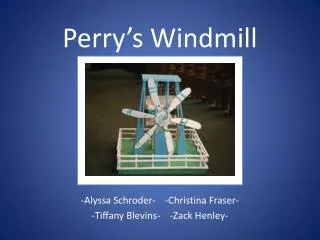
Design • Our design consists of a Kenex box structure, a generator, and a fan. • As the fan turns due to wind power the magnets will rotate within the generator producing the voltage needed.
Fan Design • Created out of balsa wood and tissue paper • Water wheel style • Supported by Kenex • Three blades • Extremely light
Generator Design • Insulated wire wrapped around a coke bottle • Wrapped 700 times • Placed and supported in a box structure • Earth magnets run within the coils • Connected to the fan
Mechanical and Electrical Aspects • Wind energy captured by the fan • The more wind the more rotations • Magnets rotate • Magnets create electrical current • Energy loss due to friction, generator resistance, and fan flaws.
Construction Issues • The generator • Difficult to create • Problem with efficiency • The fan • Fragile • Sensitive to moisture • Overall • Project was challenging • Time consuming
Efficiency • Equations • Ptheoretical = ½(ρAV3) – density(air) * surface area(fan) * air velocity • Ptested = VA – volts * amps = watts • (Ptested / Ptheoretical) * 100 = efficiency • Values • Ptheoretical = ½ * 1.225 * .0383866) * 1.73 = .115513 watts • Ptested = 1.4 * .0035 = .0049 watts • E = (Ptested / Ptheoretical) * 100 = 42.42% efficiency
Conclusion • Project was successful • Learned basic concepts of electricity and generators • Development of teamwork • Better materials could produce a higher efficiency • Spent $21.29 • This project is relevant because at a large scale windmills are used to produce green electricity for everyday life.