Efficient Data Sharing Techniques in Python and Scheme Programming
Learn how to implement instance variables in Python classes and efficient data sharing procedures in Scheme using references. Explore variable assignment and recall techniques.

Efficient Data Sharing Techniques in Python and Scheme Programming
E N D
Presentation Transcript
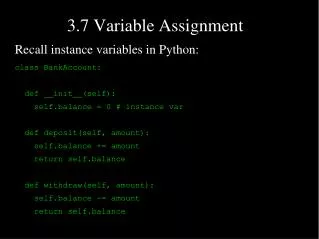
3.7 Variable Assignment Recall instance variables in Python: class BankAccount: def __init__(self): self.balance = 0 # instance var def deposit(self, amount): self.balance += amount return self.balance def withdraw(self, amount): self.balance -= amount return self.balance
Want to allow procedures to “share” data this way: --> let bal = 0 in letrec deposit(amt) = let d = set bal = +(bal, amt) in bal withdraw(amt) = let d = set bal = -(bal, amt) in bal in (deposit 100)
Add to grammar: • <expression> ::= set <identifier> = <expression> • varassign-exp (id rhs-exp) • Add to eval-expression: Must alter current env, • not just add to it. • So need a new datatype: reference, with operations setref and deref
Use Scheme vector (more efficient than list): (define-datatype reference reference? (a-ref ; just one variant (position integer?) (vec vector?))) a-ref 2 7 0 1 2 3
Now we can define setref and deref: (define setref! (lambda (ref val) (cases reference ref (a-ref (pos vec) ; only variant (vector-set! vec pos val))))) (define deref (lambda (ref) (cases reference ref (a-ref (pos vec) ; only variant (vector-ref vec pos)))))
Use setref in eval-expression: (define eval-expression (lambda (exp env) (cases expression exp ... (varassign-exp (id rhs-exp) (begin (setref! (apply-env-ref env id) (eval-expression rhs-exp env)) 1)) ; huh?
So what does apply-env-ref do? (define apply-env-ref (lambda (env sym) (cases environment env (empty-env-record () (eopl:error 'apply-env-ref “No binding...”)) (extended-env-record (syms vals env) (let ((pos (list-find-position sym syms))) (if (number? pos) ; found (a-ref pos vals) (apply-env-ref env sym)))))))
Can redefine apply-env in terms of apply-env-ref: (define apply-env (lambda (env sym) (deref (apply-env-ref env sym)))) • Why deref ? • Because apply-env-ref creates a reference structure.
Recall original example: • --> let bal = 0 • in letrec • deposit(amt) = • let d = set bal = +(bal, amt) • in bal • withdraw(amt) = • let d = set bal = -(bal, amt) • in bal • in (deposit 100) • Why is this uninteresting? What do we need?