Download
1 / 8
80 likes | 193 Vues
Delve into the world of energy, from kinetic and potential to alternative sources like solar power and hydrogen fuel cells. Understand units of work, energy, and power, and their applications in different contexts. Explore the pros and cons of gasoline, batteries, and fuel cells, and learn about the future of energy generation. Discover the exciting possibilities and challenges in the realm of energy and power.

E N D
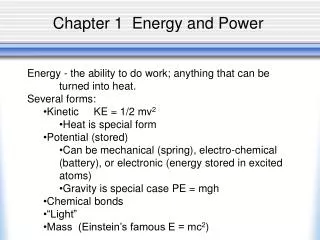
Chapter 1 Energy and Power • Energy - the ability to do work; anything that can be turned into heat. • Several forms: • Kinetic KE = 1/2 mv2 • Heat is special form • Potential (stored) • Can be mechanical (spring), electro-chemical (battery), or electronic (energy stored in excited atoms) • Gravity is special case PE = mgh • Chemical bonds • “Light” • Mass (Einstein’s famous E = mc2)
Work, Energy, Power, and their units • (Physics) Work = Force x distance • Work and energy have same units • Joules in metric • Foot-pounds in English (seldom used) • 1 Calorie = 1000 calories • Power is the time rate of doing work or the time rate of gaining or losing energy • Units of Power = Joule/sec = Watt • So kWh is a unit of energy • Energy Content Table
Alternative Energy: Gasoline, batteries, and fuel cells • Gasoline is (relatively) cheap, but has problems… • Unreliable and price may go higher • Efficiency, pollution and greenhouse gas production • So what’s wrong with batteries? • Heavy and bulky • Low energy per gram compared to gasoline • Expensive to replace (especially ones with most energy/volume) • Hybrids? • Still problems with batteries • Best with limited use of batteries (they last longer)
But the electric cars are coming! The Tesla Roadster The Chevy Volt
What’s all the hype about hydrogen? • Not mined; made from water using hydrolysis • Fuel cell creates water and electricity • Lower energy/volume than gasoline • Even when compressed (1/6 as much) or liquified (1/3 as much) • Made from methane, but produces CO2 • BUT, hydrogen fuel cells produce no pollution, not even CO2, so there may be conditions under which their use is justified. Just don’t expect a hydrogen car any time soon.
Have an eye on those tables! • Page 1-12 Notice coal and natural gas vs. gasoline • Page 1-16 Examples of energy units • Page 1-18 Examples of power units • These are really good sources of test questions!
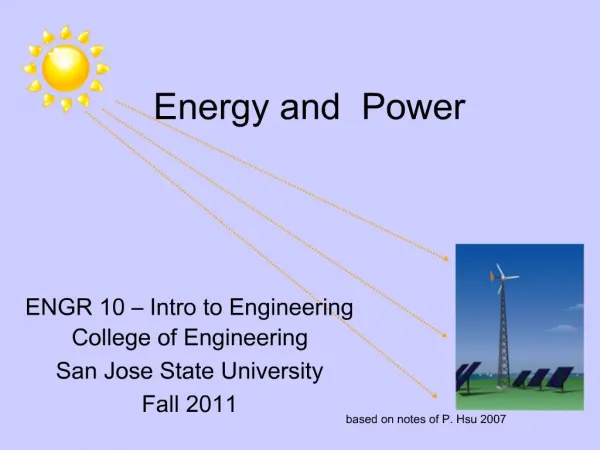
Solar Power • About 1 kW shines on 1 m2 • About 1 GW shines on 1 km2 • Take solar cell efficiency into account… • 1 m2 gives 150-400 W of electricity • 1 km2 gives 150-400 MW of electricity • Use hydrogen storage for night energy? • Solar cells are expensive and fragile
Kinetic Energy Killed the Dinosaurs Recall that KE = 1/2 mv2 • Fragment G: • 1 km diameter • 2000 kg/m3 • 60 km/s • 1000 Giga-tons of TNT