IPR Update on Patent Rights and Compliance with RFC 3979: Key Developments and Guidelines
This document outlines the latest updates regarding intellectual property rights (IPR) as they pertain to contributions from various organizations such as Xiph.org, Broadcom, and Skype. It highlights the compliance with the IETF's interpretation of RFC 3979 and provides reminders on patent disclosures, including a focus on voluntary disclosure practices. Additionally, it emphasizes the importance of a cautious approach to discussing patent rights in public and the potential impact of unnecessary discussions on patent claims during the development of specifications. Suggestions for future protocols and document structuring are also discussed.

IPR Update on Patent Rights and Compliance with RFC 3979: Key Developments and Guidelines
E N D
Presentation Transcript
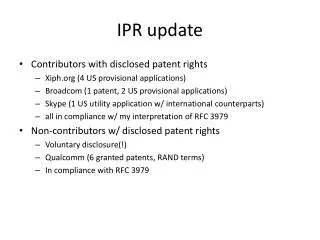
IPR update • Contributors with disclosed patent rights • Xiph.org (4 US provisional applications) • Broadcom (1 patent, 2 US provisional applications) • Skype (1 US utility application w/ international counterparts) • all in compliance w/ my interpretation of RFC 3979 • Non-contributors w/ disclosed patent rights • Voluntary disclosure(!) • Qualcomm (6 granted patents, RAND terms) • In compliance with RFC 3979
IPR policy reminder • IETF (and its working groups) takes no position on validity, utility, or applicability of patent claims • IETF (and its working groups, including Codec) have no mandatory licensing requirements. • Disclosures are made against snapshots of drafts and against RFCs, and (in most cases) stay on record.
Way forward (1) • Unwise to discuss patent rights in public • Willful infringement (less an issue since 2008, but many conservative legal groups are still cautious) • Forcing the hand of rightholders (before equitable theories such as laches/estoppel render rights unenforceable) • Strong preference of many participants not to discuss claim language on the IETF list. • Those who want to discuss, create your own non-IETF list.
Way forward (2) • Depending on language of disclosure, disclosure can relate to optional parts, examples, etc. etc. of a specification—anything that’s in a draft • Due to nature of spec development, conceivably, Opus v5 may draw in a particularly high number of patent claims • Perhaps reconsider mode of development • Perhaps remove all mechanisms related to automated mode changes • Perhaps split doc and code into normative (very concise) bitstream syntax and decoder operation, plus informative “test model” covering everything else