Recursive Definitions
Explore recursive definitions and inductive proofs including sequences, sets, functions, and examples like the Fibonacci numbers. Learn to prove recursive definitions and set equalities through inductive reasoning.

Recursive Definitions
E N D
Presentation Transcript
Recursive Definitions Rosen, 3.4
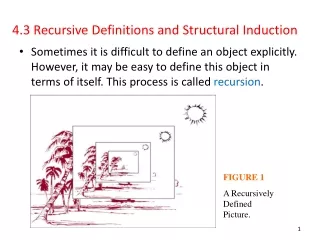
Recursive (or inductive) Definitions • Sometimes easier to define an object in terms of itself. • This process is called recursion. • Sequences • {s0,s1,s2, …} defined by s0 = a and sn = 2sn-1 + b for constants a and b and n Z+ • Sets • 3 S and x+y S if xS and yS • Functions • Example: f(n) = 2n, f(n) = 2f(n-1) and f(0) = 1
Recursively Defined Functions To define a function with the set of nonnegative integers as its domain • Specify the value of the function at zero (or sometimes, it first k terms). • Give a rule for finding its value at an integer from its values at smaller integers.
Examples of Recursively Defined Functions • Factorial Function n! • n! = n(n-1)(n-2)….(1) • f(0) = 1, f(n) = n(f(n-1)) • an • f(0) = 1, f(n+1) = f(n)*a • Fibonacci Numbers • f0=0, f1=1, f n+1 = fn + f n-1 • {0,1,1,2,3,5,8,13,...}
Prove that the nth term in the Fibonacci sequence is when n2 Induction Proof: Basic Step: Let n = 2, then f2 = 1 = =1+0 Inductive Step: Consider k2 and assume that the expression is true for 2 n k. We must show that the expression is true for n = k+1, i.e., that fk+1 fk+1 = fk +fk-1 by definition by the inductive hypothesis
Fibonacci Proof (cont.) Since f2 is true and [fn is true for 2 n k fk+1] is true, then fn is true for all positive integers n2.
Recursively Defined Set Example Let the set S be defined recursively as 3 S and x+y S if xS and yS. Prove that S is equal to the set of positive integers divisible by 3 (set A). Proof: To show that S = A, we must show that AS and that SA.
Recursive Set Example (cont.) First we will show that A S. To do this we must show that every positive integer divisible by 3 is in S. This is the same as saying that 3n is in S for nZ+. We will do an inductive proof. Let p(n) be the statement that 3nS for n a positive integer. Basis Step: p(1) = 3(1) = 3 Inductive Step: We will show that p(n) p(n+1) Let p(n) S. Then p(n+1) = 3(n+1) = 3n + 3. Since 3nS and 3S, then 3n+3S. Therefore every element in A must be in S.
Recursive Set Example (cont.) Now we will show that SA. To do this we must show that every element in S is divisible by 3, i.e., that it can be represented as 3(j) where j is a positive integer. Basis Step: 3A since 3 = 3(1) Inductive Step: Assume x,y are in A (where x,y S). x and y are divisible by 3 since they are both in A. Therefore x = 3j and y = 3k for j,k Z+. Then z = x+y = 3j+3k = 3(j+k), which is divisible by 3, so z A (and by definition, z S). Therefore every element in S must be in A
Prove fn > n-2 where = (1+5)/2 whenever n3 Inductive Proof Basis Step: First we will show fn > n-2 for f3 and f4. 3-2 = 1 = (1+5)/2 < (1+9)/2 = 4/2 = 2 = f3 4-2 = 2 = [(1+5)/2]2 = (1+ 25 + 5)/4 = (6+ 25)/4 = 3/2 + 5/2 < 3/2 + 9/2 = 3 = f4
fn > n-2(cont.) Inductive Step: Assume that fk > k-2 is true for all nonnegative integers 3 k n when n>4 . We must show that fn+1> n-1. Lemma: 2 = [(1+5)/2]2 = (1+25 +5)/4 = 3/2 + (5)/2 = 1 + (1+5)/2 = 1+
fn > n-2(cont.) n-1 = 2n-3 = (+1)(n-3) = n-2+n-3 By our inductive hypothesis fn-1 > n-3 and fn > n-2 fn+1= fn + fn-1 > n-2+n-3 =n-1 Since f3 and f3 are true and fk is true for 3 k n fn+1 is true, then fn is true for all positive integers n3
Find a closed form solution to the recursive equation: T(n) = T(n-1) + c1. T(0) = c0 One approach is to write down several terms, guess what the equation is, and then prove that your guess is correct (or not) using an induction proof. T(0) = c0 T(1) = T(0) + c1 = c0 + c1 T(2) = T(1) + c1 = c0 + 2c1 T(3) = T(2) + c1= c0 + 3c1 T(4) = T(3) + c1= c0 + 4c1 Guess that T(n) = c0 + nc1
Induction proof Basis Step: for n = 0, T(0) = c0 + (0)c1 = c0 Inductive Step: Assume that T(n) = c0 + nc1, we must show that T(n+1) = c0 + (n+1)c1. T(n+1) = T(n) + c1 = c0 + nc1 + c1 = c0 + (n+1)c1.
Find a closed form solution to T(1) = c0, T(n) = 2T(n-1)+c1 T(1) = c0 T(2) = 2T(1) + c1 = 2c0 + c1 T(3) = 2T(2)+c1 = 2(2c0+c1)+c1 = 4c0+3c1 T(4) = 2T(3)+c1 = 2(4c0+3c1)+c1 = 8c0+7c1 T(5) = 2T(4)+c1 = 2(8c0+7c1)+c1 = 16c0+15c1 Guess that T(n) = 2n-1c0 + (2n-1-1)c1
Prove that T(1) = c0, T(n) = 2T(n-1)+c1has closed form solution T(n) = 2n-1c0 + (2n-1-1)c1 Basis Step: T(1) = 21-1c0 + (21-1-1)c1 = c0 Induction Step: Assume that T(n) = 2n-1c0 + (2n-1-1)c1. We must show that T(n+1) = 2(n+1)-1c0 + (2(n+1)-1-1)c1 = 2nc0 + (2n-1)c1. T(n+1) = 2T(n) + c1 = 2[2n-1c0 + (2n-1-1)c1]+ c1 = 2nc0 + (2n-2)c1 + c1 = 2nc0 + 2nc1 - c1 = 2nc0 + (2n-1)c1.