

SlideServe
Menu
Préférences
© SlideServe · v2026

Laser Guide Stars

prue avatar
26 diapositives · 531 Views · Aug 08, 2014

Laser Guide Stars. b y Roberto Ragazzoni INAF – Astronomical Observatory of Padova (Italy) r oberto.ragazzoni@oapd.inaf.it. What are Laser Guide Stars?. They are artificially generated sources of light.. Light is pumped into the atmosphere from the ground…
Laser Guide Stars - slide 1
01 / 26Laser Guide Stars
1 / 17

Télécharger la présentation

Laser Guide Stars
Une image / un lien ci-dessous est fourni (tel quel) pour télécharger la présentation

Politique de téléchargement : le contenu du site vous est fourni TEL QUEL pour votre information et votre usage personnel ; il ne peut être vendu, concédé sous licence ni partagé sur d’autres sites sans l’accord de son auteur.Le contenu vous est fourni TEL QUEL, pour votre information et votre usage personnel uniquement. Téléchargez la présentation en cliquant sur ce lien. Lors du téléchargement, si vous ne parvenez pas à télécharger une présentation, l’éditeur a peut-être supprimé le fichier de son serveur.Pendant le téléchargement, si vous ne parvenez pas à obtenir une présentation, le fichier a peut-être été supprimé par l’éditeur.

F I N

Plus de contenu associé

Transcription de la présentation
  1. Laser Guide Stars by Roberto Ragazzoni INAF – Astronomical Observatory of Padova (Italy) roberto.ragazzoni@oapd.inaf.it

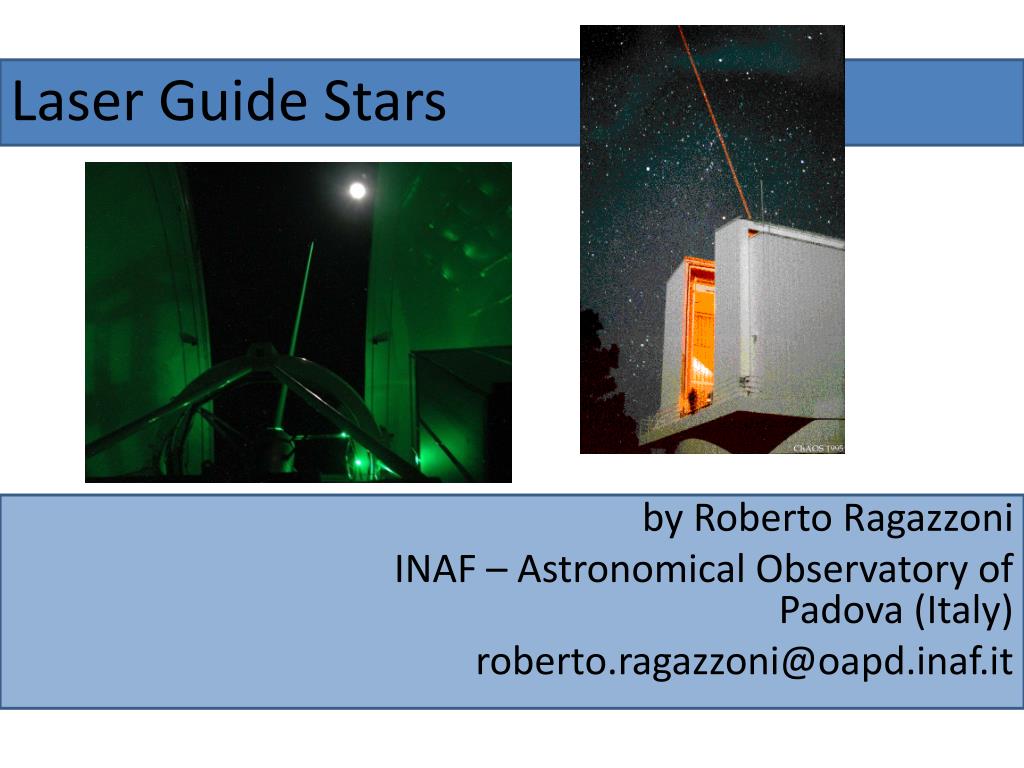
  2. What are Laser Guide Stars? • They are artificially generated sources of light.. • Light is pumped into the atmosphere from the ground… • …in some way they produces some lights that fly back to the ground… • …and this is perceived as a sort of artificial star that can be used as reference for Adaptive Optics.

  3. Rayleigh vs. resonant scattering Only specific atoms Excited at a specific wavelength All particles and aerosols in the atmosphere

  4. Problems of LGSs • Tip-tilt indetermination problem • Conical anisoplanatism • Focus at a finite distance • Rayleigh fratricide effects • Actual distance depends upon altitude and layer local variations • Cyrrus can make large scattered light • Aircraft and satellite hazards • You need a working laser!

  5. UP tilt DOWN tilt

  6. Pulsed vs. CW lasers… • Rayleigh positively needs pulsed lasers and a gating system synchronized with the laser • Sodium lasers has to comply with saturations of Sodium layer so CW are superior, in general.. • Be warned that Lasers can have micro and macro pulses…

  7. Beam expander exit and folding flat Launch mirror Wavefront sensor Laser units Laser platform Laser & Launch system • System layout • Laser source availability • Launch layout • Mechanical layout • Electronics layout LBT Laser Phase A Review

  8. A dye laser…

  9. A dye laser…

  10. A z-invariant WFS…

  11. Polychromatic LGS • A combination of wavelengths close one to each other is sent up… • ..the resonant scattering pumps up some electrons level such that in the decay two very different wavelengths are sent back… • So the way-UP is wavelength independent while the way-DOWN is not… • …a little signal with absolute tilt information.

  12. Laser Guide Stars… • Are now in operation at Keck, Gemini and VLT… • Science is mostly with spectroscopy… • Some telescopes are more effective than others… • Foreseen in various telescopes • Tilt and low orders is made through NGSs • Still sky coverage is not 100% and some significant FoV is required… • …MCAO with NGSs…????