Explore the Amazon Rainforest: A Biodiverse Wonder of Nature
The Amazon Rainforest spans approximately 1.2 billion acres and plays a crucial role in the Earth's ecosystem, producing one-third of the world’s oxygen and home to countless species of flora and fauna. Covering 60% of Brazil and extending into several neighboring countries, it is a habitat for tree frogs, monkeys, and more than 1,400 bird species. The rainforest’s dense canopy is vital for many animals and contributes to the planet's biodiversity. Unfortunately, illegal wildlife trade and deforestation threaten this invaluable resource, underscoring the need for preservation efforts.

Explore the Amazon Rainforest: A Biodiverse Wonder of Nature
E N D
Presentation Transcript
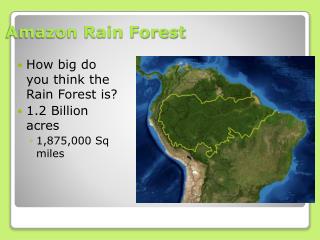
How big do you think the Rain Forest is? • 1.2 Billion acres • 1,875,000 Sq miles Amazon Rain Forest
60% in Brazil • Col., Peru, Ven, Ecu, Bol, Guya., Sur, and Fr. Guiana Where is it?
Basin formed 50 million years ago • Brazilian Highlands and Guiana Highlands wore down • Left the Amazon River as a drain • Worlds Largest River Guiana Highlands BASIN Andes Mountains Brazilian Highlands
Francisco de Orellana (Spanish conquistador, first European) • ran into a tribe of fierce women warriors • "doing as much fighting as ten Indian men." • Orellana recalled the Greek myth of warrior women and named the entire river "Amazonas.” Where does the name come from?
Canopy- dense mass of leaves at the tops of rain forest trees that provides habitat and shade • Most animal life lives in the canopy • Tree frogs, salamanders, monkeys, swarms of insects, and about 1,400 species of birds
More types of butterflies than anywhere in the world • Worlds largest rodent: capybara • There is a lucrative illegal wildlife trade • Smugglers look for monkeys, parrots, lizards, and exotic bugs • parrot = $10,000 monkey = $50,000
Bad for the whole planet = 1/3 of the world’s oxygen comes from rainforests • Photosynthesis- process of plants creating food from CO2, H2O, and Sunlight • Holds 1/5 for worlds fresh water Effects of Cutting down the RF
World’s larges continental mountain range • Western Coast of S.A • Over 4,500 miles long • 120-430 miles wide • Average Height of 13.000 ft • Highest Peak: Aconcagua • Seven Countries: Arg, Bol, Chi, Col, Ecu, Per, Ven
Along the Ring of Fire – Zone of Volcanic activity • Contains Many active volcanoes
Climate varies • Why? • South = rainy and cool • Central = Dry • North= rainy and warm • Average temp in Col = 64 deg F
Tobacco and Potatoes originated in Andes • Polylepis – High altitude forests and woodlands found in Andes • Trees only found around 15,000 ft above sea level
Incas practiced irrigation 6.000 years ago • Terracing is quite common • Potatoes and Maize important = staple food source • Tobacco, coffee, and cotton leading export crops • Coca important for legal local use in “mildly simulating” herbal teas.