Understanding Federal Courts: Jurisdiction, Standing, and the Role of Amicus Curiae
70 likes | 201 Vues
This guide explores the essential aspects of federal courts, emphasizing concepts like standing to sue, justiciable disputes, and the roles of both plaintiffs and defendants. It highlights the significance of amicus curiae—“friends of the court”—who provide additional perspectives. Using the case of Hoffman v. Luna as an example, the material addresses key questions such as who has standing to sue, jurisdiction types (original vs. appellate), and the structure of federal district courts. Lastly, it outlines the implications of diversity of citizenship and the U.S. Attorney's role in federal law prosecution.


Understanding Federal Courts: Jurisdiction, Standing, and the Role of Amicus Curiae
E N D
Presentation Transcript
Ch. 16 Federal courts (Hoffman’s favorite!)
Intro to courts • Standing to sue: Gives you a reason to take someone to court. • Must have a serious interest in a case/directly involved • Also must be of justiciable disputes • Issues that can be settled by legal methods. • Not trivial • Amicus curiae: “friends of the court” additional perspectives for the court to consider • Outside of plaintiff and defendant
Identify! • Hoffman v. Luna • Who’s the defendant? Who’s the Plaintiff • Issue: On Nov. 1 2013 Jarrett Luna assaulted 3 month old Jebediah Hoffman at 2am with his shoe. • Who has the standing to sue? Why? • Is this a justiciable suit? • Why or why not?
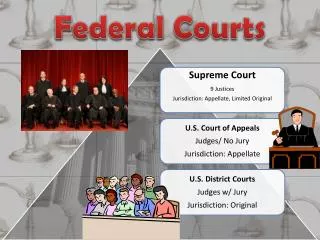
How do I get to the supreme court? • Original Jurisdiction: Where a court case begins • Determines the nature of the case. • 90% of cases begin and end here • Appellate Jurisdiction: hear cases brought to them on appeals. • Only legal issues, not case specifics. • Appeals typically end at the US State Supreme Courts.
District Courts • 91 federal district courts • The only fed. Court to use juries • Hear the following cases: • Federal crimes • Civil suits under federal law • Supervision of bankruptcy proceedings • Supervisions and naturalization of aliens
Want to sue a state?! • Sure can! • Diversity of citizenship • A case where citizens of one state, can file suit against different states. • Cases of matters over $75,000 • US Attorney: nominated by the President to prosecute violation of federal law. • All 91 courts have one
Appeal to a higher power… • Review all final decisions of the district courts • Also enforces decisions of federal regulatory commissions • 12 judicial circuits • Serves at least two states • 6-28 judges • “en banc” all judges present