Download
1 / 3
30 likes | 172 Vues
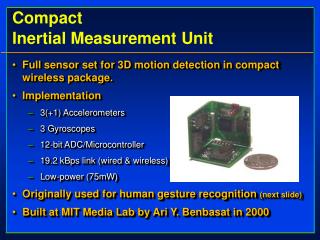
This advanced Compact Inertial Measurement Unit (IMU) features a complete sensor set that includes 3 accelerometers and 3 gyroscopes, designed for effective 3D motion detection. With a high-resolution 12-bit ADC and a microcontroller, the IMU operates at a low power consumption of just 75mW and supports a data link of 19.2 kBps in both wired and wireless modes. Originally developed for human gesture recognition at MIT Media Lab as part of a Master’s thesis, this device enables direct sensing, low-complexity algorithms, and supports gesture analysis for various applications.

E N D
Compact Inertial Measurement Unit • Full sensor set for 3D motion detection in compact wireless package. • Implementation • 3(+1) Accelerometers • 3 Gyroscopes • 12-bit ADC/Microcontroller • 19.2 kBps link (wired & wireless) • Low-power (75mW) • Originally used for human gesture recognition (next slide) • Built at MIT Media Lab by Ari Y. Benbasat in 2000
AYB Master’s Thesis Work • Create analysis and interpretation framework for inertial devices: • Analysis: Activity detection • Gesture Recognition: Parameterized atomic gestures • Output Scripting: Links gestures to outputs • Benefits: • Allows direct, in situ sensing of quantities of interest • Low complexity of algorithms allows for stand-alone devices Project Organization
Sample Gesture Analysis Perform Gestures and Collect Data Find Areas of Activity y x (no rotation) Run Recognition Recombine Atomic Output 2 Peaks = + = = 3 Peaks