Exploring the Fascinating History and Nature of Comets
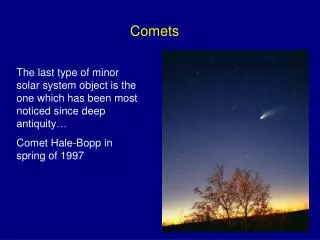
Comets, known as "the hairy ones" from the Greek word 'kometes', have intrigued humanity for millennia. The earliest observations date back to around 1000 BC in China and Chaldea (modern-day Iraq). Ancient philosophers, such as the Pythagoreans, viewed comets as wandering planets, while Aristotle classified them as sub-lunar phenomena. Comets orbit the Sun in elongated paths and can take years to centuries for a complete revolution. As they approach the Sun, they develop a coma and two distinct tails made of dust and ionized gas. Discover the mysteries of these celestial wonders!

Exploring the Fascinating History and Nature of Comets
E N D
Presentation Transcript
Comets By: Christian Moreno, Kamryn Johnson, Emily McDonald
The word “comet” now used in all European languages , comes from the Greek word kometes meaning ‘the hairy one, but the earliest extant records of cometary observations date from around -1000 in China and probably from about the same time in Chaldea (around present-day Iraq). Ideas about the true nature of comets are available from the time of the rise of Hellenistic natural philosophy at about -550 when the Pythagoreans considered comets to be a kind of (wandering) planets that were seen rather infrequently and mostly near the horizon in the morning or evening sky. Aristotle in his Meteorology (ca. -330) relegated comets to the lowest, `sub lunar' sphere in his system of spherical shells and described them as `dry and warm exhalations' in the upper atmosphere. History of Comets
Location A comet orbits the Sun in a long egg-shaped path. It can take a comet anywhere from a few years to hundreds of years to orbit the Sun.
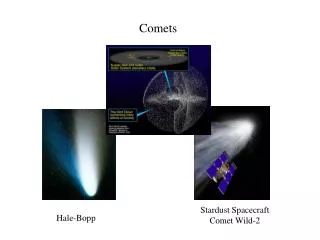
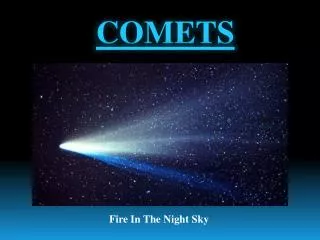
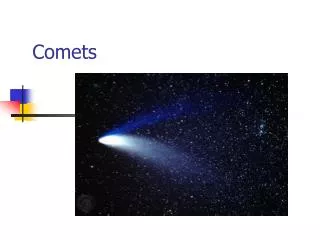
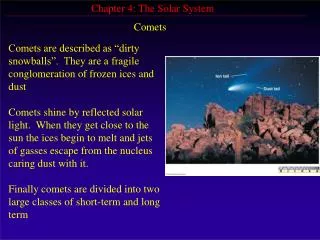
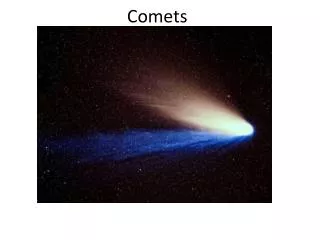
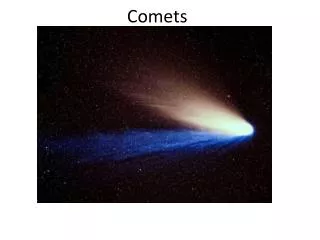
Physical Properties Comets may be icy bodies a few km or less in diameter. At smaller distances from the sun, the nucleus of a comet will begin to vaporize, thereby generating a large neutral atmosphere, or coma. Two tails are also produced, one of which consists of dust particles entrained in the coma gas during vaporization and then separated from the coma by radiation pressure, while the other consists of ionized molecules swept back by the solar wind.
Sources http://www.eso.org/public/events/astro-evt/DeepImpact/Background/comet-history-1.html http://www.kidseclipse.com/pages/a1b3c0d5.htm