Learning to Rank with High-Order Information for Action Recognition
10 likes | 126 Vues
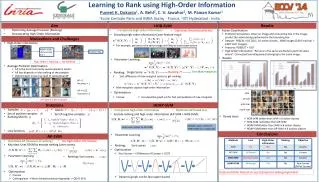
This research presents an innovative approach to ranking using High-Order Information via HOB-SVM. We aim to optimize Average Precision for action classification by integrating high-order data. The problem is framed as predicting the action within a bounding box, utilizing the PASCAL VOC 2011 dataset. Our method incorporates joint feature maps to leverage the correlation between persons in the same image. Experimental results show that our model, HOAP-SVM, outperforms traditional SVMs and demonstrates effective optimization strategies for action recognition tasks.


Learning to Rank with High-Order Information for Action Recognition
E N D
Presentation Transcript
Learning to Rank using High-Order Information Puneet K. Dokania1, A. Behl2, C. V. Jawahar2, M. PawanKumar1 1Ecole Centrale Paris and INRIA Saclay - France, 2IIIT Hyderabad - India Aim Results HOB-SVM • Optimizing Average Precision (Ranking) • Incorporating High-Order Information • Incorporate High-order information • Optimizes Decomposable loss • Action Classification • Problem Formulation: Given an image and a bounding box in the image, predict the action being performed in the bounding box. • Dataset- PASCAL VOC 2011,10 action classes,, 4846 images(2424 ‘trainval’ + 2422 ‘test’ images). • Features: POSELET + GIST • High-Order Information: “Persons in the same are likely to perform same action”. Connected bounding boxes belonging to the same image. • Encoding high-order information (joint feature map): Motivations and Challenges • For example, persons in the same image are likely to have same action • High-Order Information • Results • Parameter Learning: High Order + Ranking -> No Method • Average Precision Optimization • AP is the most commonly used evaluation metric • AP loss depends on the ranking of the samples • Optimizing 0-1 loss may lead to suboptimal AP Action inside the bounding box ? Use Max-marginals Context helps Ranking ?? Single Score • Ranking: • Sort difference of max-marginal scores to get ranking: AP = 1 Accuracy = 1 • Max-marginals capture high-order information AP = 0.55 Accuracy = 1 • Optimization: Notations • Use dynamic graph cut for fast computation of max-marginals • Convex AP doesn’t decompose • Samples: • Labels: • Set of positive samples: HOAP-SVM • Set of negative samples: • Ranking Matrix: • Optimizes AP based loss • Incorporate high-order information SVM • Encode ranking and high-order information (AP-SVM + HOB-SVM): • Paired ttest: AP-SVM • HOB-SVM better than SVM in 6 action classes • HOB-SVM not better than AP-SVM • HOAP-SVM better than SVM in 6 action classes • HOAP-SVM better than AP-SVM in 4 actions classes • Loss function: HOB-SVM AP-SVM Sample scores similar to HOB-SVM (max-marginals) Joint score similar to AP-SVM HOAP-SVM • Optimizes AP (measure of ranking) Conclusions • Parameter Learning • Key Idea: Uses SSVM to encode ranking (joint score): • No High-Order Information • Ranking: Sort scores • Parameter Learning • Ranking: Sort scores, • Optimization • Non Convex - > Difference of Convex -> CCCP • Optimization • Convex • Cutting plane -> Most violated constraint (greedy) -> O(|P||N|) Code and Data: http://cvn.ecp.fr/projects/ranking-highorder/ • Dynamic graph cut for fast upper bound