Understanding Data Units: Bits, Bytes, and Gigabytes Explained
This guide provides a clear understanding of data communication and storage units. It explains the relationship between bits, kilobits, megabits, and gigabits, highlighting that 1000 bits equals 1 Kb, 1000 Kbs equals 1 Mb, and 1000 Mbs equals 1 Gb. Additionally, it covers data storage units, noting that 8 bits make up 1 byte, and how 1024 bytes, 1024 KB, and 1024 MB ultimately result in 1 GB. The mathematical breakdown helps demystify the power of 2 used in computing, such as how 8,589,934,592 bits equal 1 GB.

Understanding Data Units: Bits, Bytes, and Gigabytes Explained
E N D
Presentation Transcript
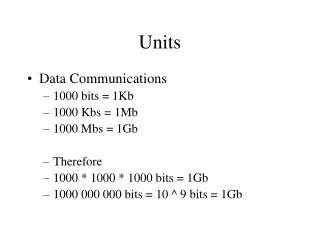
Units • Data Communications • 1000 bits = 1Kb • 1000 Kbs = 1Mb • 1000 Mbs = 1Gb • Therefore • 1000 * 1000 * 1000 bits = 1Gb • 1000 000 000 bits = 10 ^ 9 bits = 1Gb
Units • Data Storage • 8 bits = 1 byte • 1024 bytes = 1 KB • 1024 KB = 1 MB • 1024 MB = 1 GB Therefore 8 * 1024 * 1024 *1024 bits = 1 GB 8 589 934 592 bits = 1 GB