Background on Maize and Photosynthesis
380 likes | 806 Vues
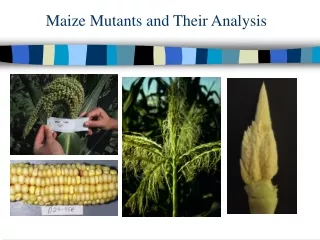
Background on Maize and Photosynthesis. Corn or Maize – Zea mays. Typical Corn Growth. Typical ear of corn. Zea mays subsp. mexicana. Zea mays subsp. mays. Teosinte vs. Corn Growth. Teosinte Corn. Steps from Teosinte to Maize.


Background on Maize and Photosynthesis
E N D
Presentation Transcript
Corn or Maize – Zea mays
Zea mays subsp. mexicana Zea mays subsp. mays
Teosinte vs. Corn Growth Teosinte Corn
Steps from Teosinte to Maize • Maize cobs do not shatter (fall apart) whereas teosinte ears shatter when mature • Each teosinte grain is netled in a hard, deep floral structure the cupule and covered by a hard sheath (the glume). The grains of corn are naked and held outside a collapsed cupule • Each teosintecupule contains a single fertile spikelet; maize cupules have two fertile spikelets • Teosinte cupules are arranged in 2 ranks (rows) but maize are in 4 to 10 rows • Teosinte has long primary branches that each ends in a male tassel and there are numerous tiny ears along each branch. Maize has short primary branches that end in a single ear – only a few ears per plant; male tassel at apex of plant
Variation in ear size and kernel color fromMexican landraces of corn
Teosinte – Zea diploperennis
Light and Dark Reactions • We shall see that the first, light-dependent stage of photosynthesis uses light energy to form ATP from ADP and to reduce electron carrier molecules, especially NADP+ to NADPH – so here energy is captured • In the light-independent reaction, the energy from the ATP and NADPH is used to build organic carbon molecules - and this is the process of carbon fixation
Light Spectrums • Absorption spectrum - the light absorption pattern of a pigment • Action spectrum - the relative effectiveness of different wavelengths for a specific light-requiring process - such as photosynthesis, flowering or phototropism
When pigments absorb light, electrons are temporarily boosted to a higher energy level One of three things may happen to that energy: 1. the energy may be dissipated as heat 2. the energy may be re-emitted almost instantly as light of a longer wavelength - this is called fluorescence 3. the energy may be captured by the formation of a chemical bond - as in photosynthesis
The Photosynthetic Pigments • Chlorophyll a - found in all photosynthetic eukaryotes and cyanobacteria - essential for photosynthesis in these organisms • Chlorophyll b - found in vascular plants, bryophytes, green algae and euglenoid algae - it is an accessory pigment • Carotenoids - red, orange or yellow fat-soluble accessory pigments found in all chloroplasts and cyanobacteria - caroteniods are embedded in thylakoids along with chlorophylls • Two types of carotenoids - carotenes and xanthophylls
Overview Of Photosynthesis
Melvin Calvin 1940s • Worked out the carbon-fixation pathway – now named for him • Won Nobel Prize in 1961
Calvin Cycle Summary • Each full turn of the Calvin cycle begins with entry of a CO2 molecule and ends when RuBP is regenerated - it takes 6 full turns of the Calvin cycle to generate a 6 carbon sugar such as glucose • the equation to produce a molecule of glucose is: • 6CO2 + 12NADPH + 12H+ + 18ATP => 1 Glucose + 12NADP + 6O2 + 18ADP + 18 Pi + 6H2O
C4 Pathway • In some plants the first carbon compound produced through the light-independent reactions is not the 3 carbon PGA, but rather is a 4 carbon molecule oxaloacetate • Leaves of C4 plants typically have very orderly arrangement of mesophyll around a layer of bundle sheath cells – called Kranz architecture • Mesophyll cell chloroplasts are small with lots of grana; bundle sheath cell chloroplasts are large with little grana
Why Use C4 Pathway? • Fixation of CO2 has a higher energetic cost in C4 plants than in C3 plants – it takes 5 ATP to fix one molecule of CO2 in C4 but only 3 ATP in C3 • For all C3 plants photosynthesis is always accompanied by photorespiration which consumes and releases CO2 in the presence of light - it wastes carbon fixed by photosynthesis - up to 50% of carbon fixed in photosynthesis may be used in photorespiration in C3 plants as fixed carbon is reoxidized to CO2 • Photorespiration is nearly absent in C4 plants - this is because a high CO2: low O2 concentration limits photorespiration - C4 plants essentially pump CO2 into bundle sheath cells thus maintaining high CO2 concentration in cells where Calvin cycle will occur • Thus net photosynthetic rates for C4 plants (corn, sorgham, sugarcane) are higher than in C3 relatives (wheat, rice, rye, oats)
CAM – Crassulacean Acid Metabolism • Crassulacean Acid Metabolism (CAM) has evolved independently in many plant families including the stoneworts (Crassulaceae) and cacti (Cactaceae) • Plants which carry out CAM have ability to fix CO2 in the dark (night) • so CAM plants, like C4 plants, use both C4 and C3 pathways, but CAM plants separate the cycles temporally and C4 plants separate them spatially • CAM plants typically open stomata at night and take in CO2 then, then close stomata during day and thus retard water loss