Download
1 / 12
120 likes | 239 Vues
This comprehensive overview of coordination chemistry delves into the concepts of ligands, bonding to metals, and donor-acceptor complexes. It defines key terms such as Lewis acids and bases, highlighting their roles in metal-ligand interactions. The text explains coordination numbers, denticity, and categorizes common ligands into monodentate, bidentate, and polydentate types with examples. Additionally, it addresses geometric isomerism in coordination complexes, showcasing variations like fac- and mer-isomers in bidentate and polydentate complexes.

E N D
Coordination Chemistry ligands bonding to metals
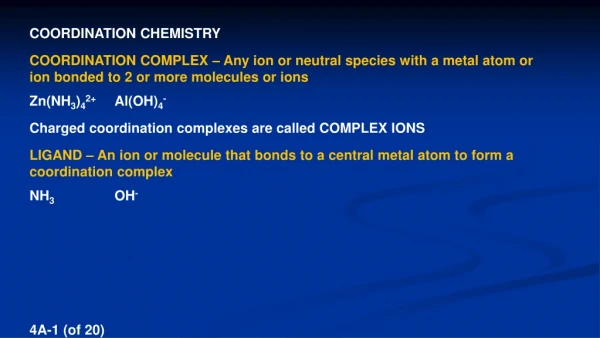
Definitions Lewis Acid = acceptor = usually a transition metal cation Lewis Base = donor = ligand = usually something with a lone electron pair Coordination number = # of metal-ligand attachments Denticity = # of attachments a ligand makes
Common Ligands Monodentate Ligands: Halides: F-, Cl-, Br-, I- O2-, S2-, OH-, CN- NH3, H2O, CO Bidentate Ligands: Polydentate Ligands: heme, salen
Bidentate ligand complexes Co(en)2Cl2 Ni(DMG)2
Bidentate complexes Co(en)32+ Fe(phen)32+
Polydentate complexes Co(salen)+ chlorophyll
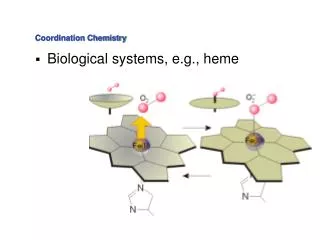
Polydentate complexes Fe-heme O2-Fe-heme
Geometric isomerism Fac- isomer Mer- isomer