Download
1 / 5
60 likes | 190 Vues
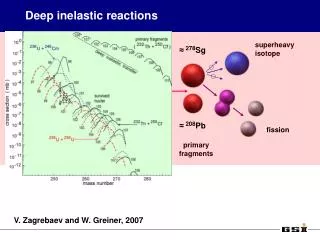
This study presents new methods for producing and analyzing superheavy isotopes, particularly around the production of approximately 278Sg through deep inelastic reactions involving 238U and 248Cm. Utilizing the SHIPtrap facility, we explore isobar separation at A=147 and identify excited isomeric states. The recent experiments focus on fusion-evaporation reactions to generate superheavy elements and analyze their decay properties, contributing to our understanding of the stability of superheavy nuclei and their fission processes.

E N D
Deep inelastic reactions V. Zagrebaev and W. Greiner, 2007 superheavy isotope ≈ 278Sg 238U 248Cm ≈ 208Pb fission primary fragments
New methods: SHIPtrap 147Ho 147Dy 147Tb 147Er Isobar separation at A=147 in the purification trap 8.44 MeV Isomeric state identification in the measurement trap Stopping cell Fusion / transfer products from SHIP Extraction RFQ Buncher Detector gs Isomer Purification trap 147Dy+ 750 keV Measurement trap Downstream experiments M. Block et al.
SHIPtrap: Most recent results, August 2008 48Ca + 208Pb=> 254No+ 2n σ= 2 b 3 ions/s into gas-cell 48Ca + 207Pb=> 253No+ 2n Excitation frequency / Hz – 846665 σ= 900 nb 48Ca + 206Pb=> 252No+ 2n σ= 400 nb BE = ± 10 keV M. Block et al.
Results Results 184 Increased stability Increased stability Deformed nuclei Deformed nuclei 162 Search for Search for Cold Cold 152 SHE SHE fusion fusion in nature, in nature, in transfer in transfer reaktions reaktions Bi-modal Bi-modal fission fission Hot Hot KIsomers KIsomers fusion fusion Chemistry of Chemistry of TA elements TA-elements “Relativistic “Relativistic effects“ in effects“ in superdeformed SFIsomers superdeformed SFIsomers SH atoms SH atoms Protons Neutrons
SHIP Collaboration S. Hofmann, D. Ackermann, M. Block, H.G. Burkhard, S. Heinz, F.P. Heßberger, B. Kindler, I. Kojouharov, B. Lommel, R. Mann, J. Maurer, G. Münzenberg, H.J. Schött, B. Sulignano Gesellschaft für Schwerionenforschung (GSI) Darmstadt, Germany A.G. Popeko, A.V. Yeremin Flerov Laboratory of Nuclear Reactions, JINR Dubna, Russia S. Antalic, S. Saro,B. Streicher Department of Nuclear Physics, Comenius University Bratislava, Slovakia P. Kuusiniemi, M. Leino, J. Uusitalo Department of Physics, University of Jyväskylä Jyväskylä, Finland K. Nishio Japan Atomic Energy Research Institute Tokai, Japan Z. Gan Institute of Modern Physics(IMP) Lanzhou, China R. Dressler Paul-Scherrer Institute (PSI) Villigen, Switzerland