Understanding COM and ActiveX: Principles and Implementation
This course provides an in-depth exploration of Component Object Model (COM) technologies, including JavaBeans and ActiveX, emphasizing their role in software development. Participants will learn about fundamental concepts such as interface pointers, reference counting, class factories, and the lifecycle of COM objects. The course covers the importance of GUIDs, actions related to IUnknown, and how COM supports various programming languages through its interface. Real-world examples and a comparison of COM-based technologies will illustrate best practices in utilizing these frameworks.

Understanding COM and ActiveX: Principles and Implementation
E N D
Presentation Transcript
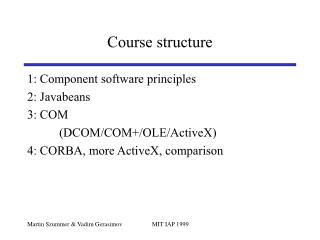
Course structure 1: Component software principles 2: Javabeans 3: COM (DCOM/COM+/OLE/ActiveX) 4: CORBA, more ActiveX, comparison MIT IAP 1999
COM-based technologies ActiveX [set of COM-based technologies] OLE – Object Linking and Embedding [standards for compound documents] COM – Component Object Model [open specification] MIT IAP 1999
COM • Open component specification • Language/platform independent • IS NOT just library, class library, or API MIT IAP 1999
COM components • In Win32: either EXE (server) or DLL (in-process server) • Language independent • Can be shipped in binary form • Can be upgraded without breaking old clients • Can be transparently relocated on network MIT IAP 1999
Object Function1(...) { ... } Function2(...) { ... } Function3(...) { ... } ... COM Interface • COM deals with interface pointers • Interface is implemented as a virtual function table Interface Pointer Interface Pointer Interface Function Table Pointer to Function1 pointer Pointer to Function2 Pointer to Function3 ... MIT IAP 1999
Interface names • For people: ISomething – may not be unique • For software: 128-bit IID or GUID (globally unique identifier) generated based on time and network address by UUIDGEN utility MIT IAP 1999
IUnknown • All COM interfaces inherit from IUnknown: • QueryInterface - finds object’s interface by IID, and returns pointer to it • AddRef, Release – reference counting MIT IAP 1999
Reference Count • Indicates how many clients use the same object • Increments when object passes pointer to one of its interfaces • Each client must call Release after it finishes using object interface • Object may destroy itself when reference count drops to 0 MIT IAP 1999
COM Classes • Every COM object is an instance of a class • Class can be assigned a GUID called a class identifier (CLSID) • A class identifies the implementation of a group of interfaces • Class names and CLSIDs are in a database. Win32 uses the registry to save them. MIT IAP 1999
COM Library • Group of functions that supply basic services for clients and objects • Locates and starts servers for requested classes • CoCreateInstance, CoCreateInstanceEx, CoGetClassObject, CoRegisterClassObject MIT IAP 1999
Server (1) “Create an Object” Client Class Factory (3) Return new (2) Manufacture interface pointer Object to client Object Class Factory • IClassFactory – interface for efficient generation of multiple instances of a class • Methods: CreateInstance, LockServer MIT IAP 1999
Containment Aggregation knows IUnknown IUnknown knows A, B, and C A, B, and C External External Interfaces Interfaces IUnknown IUnknown controls Inner controls Inner Outer Object uses Inner Object Object lifetime Object lifetime Inner Object’s C delegates IUnknown implementation calls to Outer Object as any client. Inner Object : Inner Object : Contained inside Contained inside Inner Object’s Outer Object Outer Object C exposed directly from Outer Object Object Reusability Outer Object Outer Object A A B B C C C MIT IAP 1999
In-Process Object Local Stub Object Client Application Local Object Proxy Remote Object Proxy Remote Stub Object Distributed COM Client Process Local Server Process In-Process Server COM Local Server RPC Remote Machine COM Remote Server Process RPC COM Remote Server MIT IAP 1999
Dispatch Interface • IDispatch originally designed for Visual Basic • Invoke, GetIDsOfNames, GetTypeInfo, GetTypeInfoCount • Late binding MIT IAP 1999
Dual Interfaces • Dispinterface that includes virtual function table to access its functions • Supports both late and early binding • Good for all languages MIT IAP 1999
Interface Definition Language (IDL) • Example [ object, uuid(a817e7a2-43fa-11d0-9e44-00aa00b6770a), dual, helpstring("IComponentRegistrar Interface"), pointer_default(unique) ] interface IComponentRegistrar : IDispatch { [id(1)] HRESULT Attach([in] BSTR bstrPath); [id(2)] HRESULT RegisterAll(); [id(3)] HRESULT UnregisterAll(); [id(4)] HRESULT GetComponents([out] SAFEARRAY(BSTR)* pbstrCLSIDs, [out] SAFEARRAY(BSTR)* pbstrDescriptions); [id(5)] HRESULT RegisterComponent([in] BSTR bstrCLSID); [id(6)] HRESULT UnregisterComponent([in] BSTR bstrCLSID); } MIT IAP 1999
Interface Definition Language (IDL) • Type libraries (TLB) • ITypeLib, ITypeInfo • Proxies and Stubs • MIDL – IDL compiler MIT IAP 1999
Persistence • IStorage = file system • IStream = file • IPersist* interfaces MIT IAP 1999
Monikers • names specific object instance • knows how to create and initialize its object • Methods: BindToObject, BindToStorage, Reduce, ComposeWith, IsRunning • Composite monikers MIT IAP 1999
Uniform Data Transfer • Single scheme for moving data between applications • Clipbord, drag and drop • IDataObjectInterface: GetData, SetData, … • IAdviseSink MIT IAP 1999
Connectable object Client IConnectionPointContainer IConnectionPoint Sink Sink Outgoing interface IConnectionPoint Sink Outgoing interface Sink Connectable Objects MIT IAP 1999
Threading Models • Single • Apartment • Free • Mixed (Apartment or Free) MIT IAP 1999
OLE Compound Documents • Containers and servers • Image caching • IOleObject, IOleClientSite, IOleCache, … MIT IAP 1999
ActiveX controls and containers Container and control interfaces: IOleInPlaceActiveObject ActiveX control Control container IOleInPlaceUIWindow IOleInPlaceObject IOleInPlaceFrame IOleObject IOleInPlaceSite IDataObject IOleInClientSite IViewObject2 IAdviseSink IRunnableObject IOleCache2 IPersistStorage MIT IAP 1999
Methods, properties, events • Methods – just methods • Properties – GetProperty/SetProperty or Property methods: HRESULT Source([out, retval] BSTR* path); HRESULT Source([in] BSTR path); // OR HRESULT GetSource([out, retval] BSTR* path); HRESULT SetSource([in] BSTR lpszNewValue); • Events – methods control invokes on its client (container) MIT IAP 1999
ActiveX in html • ActiveX components can be placed on a web page • Web browser can automatically install missing components < OBJECT ID=“ctlFind” type=“application/x-oleobject” CLASSID=“CLSID:D3E12F4B-0795-11d2-91CC-00C04FA31C90” codebase="http://fdl.msn.com/public/investor/v6//investor.cab#version=6,1998,1031,3" width=72 height=19 align=middle > <param name="ServerRoot" value="http://investor.msn.com"> <param name="PageURL" value="/charts/charting.asp"> <param name="InvType" value="1"> </OBJECT> MIT IAP 1999
Versioning • Immutable interfaces • Multiple interfaces • no merging of interfaces • Emulate other class: CoTreatAsClass • Generic services MIT IAP 1999
COM object multiple interfaces interface inheritance polymorphism through multiple interfaces multiple implementing objects no persistent identity: e.g. monikers C++ object multiple inheritance polymorphism through public inheritance single implementing object fragile base class problem COM object vs. C++ object MIT IAP 1999