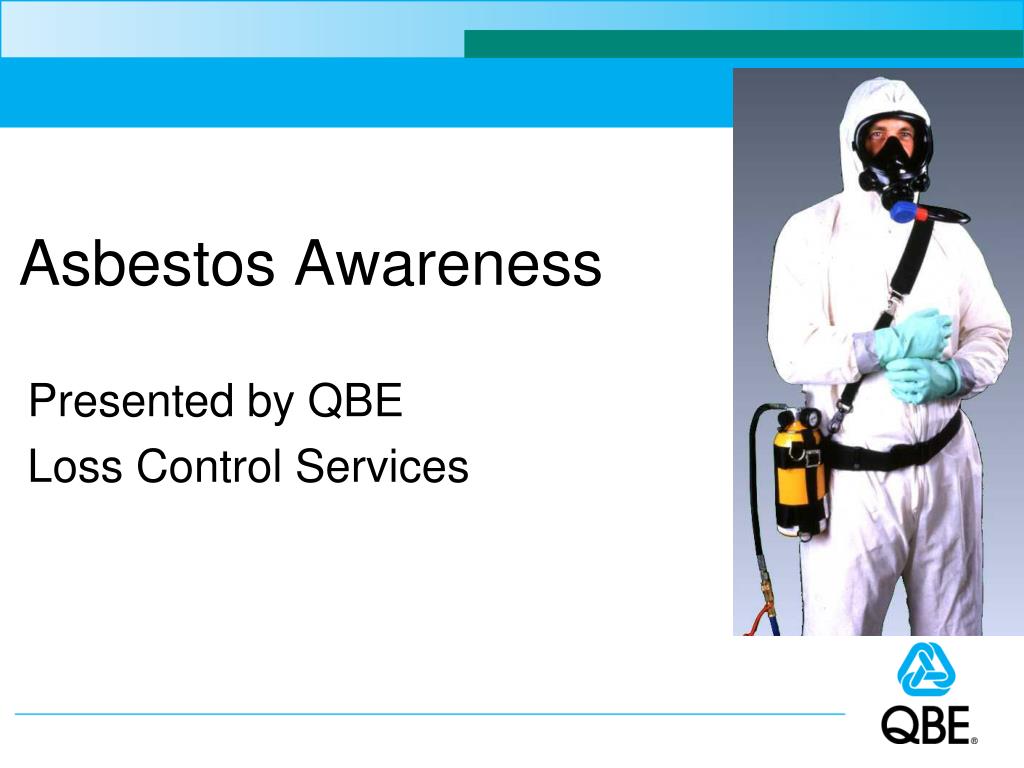
Asbestos Awareness Presented by QBE Loss Control Services
Asbestos Awareness
What is Asbestos ? • Generic term for various fibrous mineral silicates • Fibers very resistant to heat and chemicals and do not conduct electricity • Formerly widely used in many industries
Uses of Asbestos • 3600 commercial products • Use began around 1900 • Until 1940 use limited • From 1940 until 1970’s used extensively • After 1980 phase out began • 1989- EPA phase out rule
Types of Asbestos • Chrysotile • Amosite • Crocidolite • Tremolite • Actinolite • Anthophylite
Chrysotile • Most common type of asbestos • Heat resistant • Sprayed on insulation • Fireproofing • Long flexible fibers easily spun into yarn
Amosite • Not as common as chrysotile • Pipe and boiler insulation • Fibers easily become airborne
Pipe Insulation
Crocidolite • Fibers shorter and more brittle • High tensile strength • Primarily used in cement products • Fibers hard to control
Common Uses • Insulating Products (1926-1971) • Surfacing Material (sprayed or troweled) (1935-1970) • Extrusion Panels (since 1930) • Transite Boards (unknown)
Ceiling Tiles • Armstrong “Sanserra” • Armstrong “Santaglio” • Armstrong “Embossed Design”
Roofing Materials • Shingles and clapboard (unknown) • Roofing felts (since 1910) • Roofing asphalt (unknown) • Roof putty (unknown) • Roof coatings (since 1900)
Floor Materials • Mastics (1945-1980) • Asphalt tile cement (since 1959) • Vinyl asbestos tile (1950-1980) (9” x 9” tiles more likely to contain asbestos than 12” x 12” tiles) • Asphalt asbestos tile (1920-1980)
Paper Products • Corrugated (1910-1980) • Indented (since 1935) • Millboard (since 1925)
Other Products • Caulks and putties (1900-1973) • Adhesives (since 1945) • Joint compound (1945-1977) • Plaster/stucco (unknown) • Spackles (1930-1978) • Fireproofing (1935-1978) • Cements (since 1900) • Paints and coatings (1900-1978)
Spray-on Insulation
Spray-on Insulation
Asbestos in Buildings • About 20% of all buildings • About 5% with sprayed or trowled on ACM (asbestos containing materials) • About 16% with ACM on pipes or boilers • Very few with ACM ceiling tiles • About 42% with ACM containing floor tiles
Asbestos Related Diseases • Asbestosis • Lung cancer • Mesothelioma • Other Cancers
Asbestos Fiber In Lungs
Asbestosis • Lung scarring of air sacs (alveoli) • Since asbestos fibers strong, they do not break down • Asbestos fibers act as “small needles”scarring lung tissue • Scarring reduces expansion or air sacs
Asbestosis
Asbestosis Symptoms • Latency 15 years • Heavy difficult breathing • Blue skin tone • Clubbing of toes and fingers • More susceptible to colds and pneumonia • Victims usually die from heart failure
Mesothelioma • “Asbestos Cancer” • Rare- 2000 cases per year in U.S. • Cancer of the pleura (chest cavity lining) or peritoneum (abdomen wall lining) • Small fibers enter cells causing uncontrolled growth (cancer) • Increased pressure on lungs, heart and other internal organs
Mesothelioma
Mesothelioma • Latency 30 years • Painful progressive disease • 6-12 month prognosis • Death by heart attack or stroke
Mesothelioma Symptoms • Cough, chest tightness and pains • Swelling of abdomen • Dramatic weight loss • Stomach pains
Lung Cancer • Non-smokers with asbestos exposure- 5% chance • Smoker 1-pack/day and asbestos exposure- 50% chance • Smoker 2 pack/day and asbestos exposure- 95% chance
Other Disease • Cancers of colon, stomach, large intestine, esophagus • Pleural Plaques- Scars on lining of chest walls • Pleural Effusion- fluid buildup in lungs
Pleural Plaques
Who is at Risk from Asbestos? • Insulators • Boiler Makers & Repairers • Miners of Asbestos • Ship Yard Workers • Power-plant Workers • Brake Line Workers • Pipe Fitters
Exposure Limits • ACGIH-TLV as an 8 hr. time-weighted average- 0.1 f/cc (fiber per cubic centimeter of air) • OSHA PEL as an 8 hr. time-weighted average- 0.1 f/cc (1 f/cc for a 30 min. excursion period)
Exposure Factors • Concentration of fibers in air • Duration of exposure • Use of respirators and other protective measures
Release of Fibers • Friable- Loose, easily released into air. Example - spray applied materials • Non-friable- Fibers not easily released into air. Example - floor tiles
Friable Asbestos • Damaged ACM. • Fluffy, spray-applied fireproofing • Non-friable ACM can pose a hazard when sawed, sanded or during demolition
Friable Asbestos • In most cases, intact, undisturbed ACM does not pose a health hazard. Only when disturbed does a health hazard exists. • Removal of ACM may cause a problem where none existed • In-place management may be the best control method
EPA Regulations • AHERA- Asbestos Hazard Emergency Response Act -1986 Inspection and management of asbestos in schools • NESHAP- National Emission Standard for Hazardous Air Pollutants- 1973 regulates activities involving asbestos, i.e. manufacture, disposal, demolition, application, etc
Asbestos Abatement
OSHA • 1926.1101- Construction • 1910.1001- General Industry
29 CFR 1926.1101 • Demolition or salvage where asbestos present • Removal or encapsulation of ACM • Construction, alteration, repair and maintenance where asbestos is present • Installation of materials containing asbestos • Cleanup, transportation, disposal and storage of ACM
State/Local Regulations • May have separate rules • Enforcement delegated from federal government • Training and certification required in each state or local area
Contractors • Only certified contractors meeting EPA, state or local requirements allowed to perform work involving ACM
Awareness • Buildings containing ACM should be abated before contractor begins work • If materials suspected of containing ACM are encountered, stop work and contact management • Wear respiratory protection in dusty situations