Expanding Pathways between Vocational Education and Higher Education in France
80 likes | 182 Vues
In an effort to enhance opportunities and skills development, a joint meeting of the Directors-General for Vocational Education and Training (VET) and Higher Education in France was held on October 23, 2012. This gathering focused on establishing a national directory for professional qualifications and promoting collaborative partnerships among social and economic stakeholders. The discussion included improving access to vocational training through various means, such as initial and continuous training, validation of prior learning, and the involvement of local authorities to coordinate vocational training offerings effectively.


Expanding Pathways between Vocational Education and Higher Education in France
E N D
Presentation Transcript
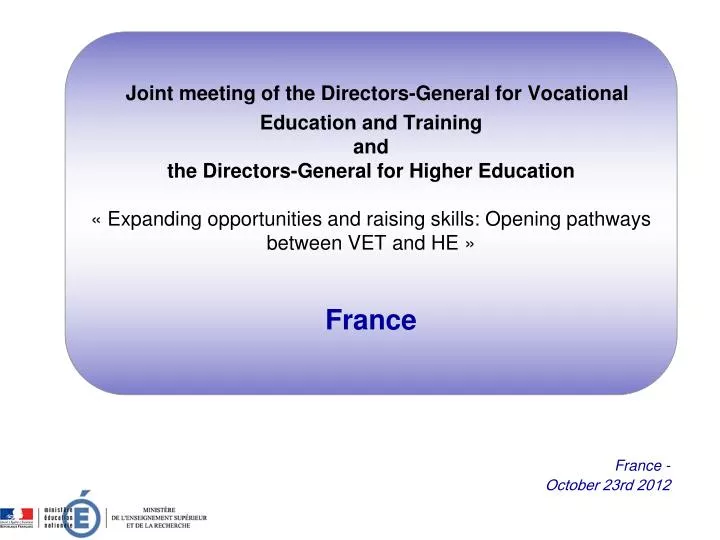
Joint meeting of the Directors-General for Vocational Education and Training and the Directors-General for Higher Education« Expanding opportunities and raising skills: Opening pathways between VET and HE »France France - October 23rd 2012
Overall context • A national Directory for professional qualifications with a registration under conditions: • Qualifications corresponding to Degrees created in a partnership framework bringing together social and economic partners. Among them, professional degrees of the French ministry for national education (EQF /Levels 3 and 4) and degrees the ministry for higher education and research is responsible for (EQF 5 and beyond) • Qualifications designed by training bodies or branches • Different ways of access to professional qualifications: • Initial vocational training (« lycées », universities, apprenticeship contracts), • Continous vocational training, • Validation (or recognition) of prior learning • An important actor : the « Régions » (local authorities with elected members), which structure and coordinate the overall vocational training offer locally.
Highereducation Lower secondary education : the “collège” (4 years from 11 to 15 years old) Primary education (5 years from 6 to 11 years old) Upper secondary education (3 or 2 years) ‘Bac Général’ ‘Bac Technologique’ ‘Bac Professionnel’ Year 3 ‘CAP’ Counselling Year 2 Year 1 General track and technologically-oriented track Vocational track
Figures 2011 Professional « Baccalauréat » • Laureates from initial vocational training • 2011 = 128.000 students in « lycéesprofessionnels » (vocational high schools) and 20.000 apprentices (apprenticeship) • Further studies in higher education for the holders of professional « baccalauréat » • 2011 : 42 %, (with among them 39% studying to get a « Brevet de technicien supérieur » - or advanced technician certificate - (BTS – EQF/level 5) • 2000 : 29 %
1st cycle « Licence »’s programmes • 2 400 000 students in 2012 (academic fall) • 34 000 students. • The 1st cycle : 1 242 000 students, four main pillars. • The ‘licences’ (universities) – ie : Bachelor’s degrees : 782 000 students – 3 300 different licences • The ‘diplômes universitaires de technologie’ - DUT - (universities) – ie : university technology-oriented degrees - : 116 000 students – 24 different subject areas • The ‘brevets de technicien supérieur ’ – BTS - (‘lycées’/post-secondary education) – 262 000 students - 88 different subject areas • The ‘classes préparatoires aux grandes écoles’ – CPGE - (‘lycées’ / post-secondary education) – 82 000 students – 26 different sorts of programmes
Professional « baccalauréat » holders in higher education 1/2 • Baccalauréat holders not well prepared for higher education … • Drop-out rate : 56 % (9% for the holders of a general baccalauréat) • … massively wishing to get into a post-secondary STS class – ‘section de technicien supérieur’ – for a BTS programme • 80 % wishes for STS registrations • … but whose wishes are rarelysatisfied
Professional « baccalauréat » holders in higher education 2/2 • Increasing the access ratio for the most suited programme • Making the access to the STS easier for the professional baccalauréat holders • Optimizing the seats left vacant • Increasing the success ratio for the degree award (to-day : a 55 % success ratio for the holders of a professional ‘baccalauréat’ versus a 85% success ratio for the holders of a general baccalauréat) • Adapting the teaching and learning methods and counselling students better along their own learning processes • Creating a 3rd way to get access to the degree award thanks to recognition of prior learning, after a 3 to 5 year- professional experience.