
Understanding Bottom Density Currents and Their Impact on Stratified Flow Dynamics
This document examines the behavior of bottom density currents in stratified flows, highlighting key phenomena such as the instantaneous concentration variance and mean concentration fields. It details experimental observations from various setups, including cylindrical objects in uniform currents and turbulence in offshore wind farms. The analysis focuses on the mechanisms of dilution in stratified flows, driven by molecular diffusion, turbulent mixing, and the effects of Kelvin-Helmholtz billows. The study contributes to a deeper understanding of turbulent mixing processes in marine environments.

Understanding Bottom Density Currents and Their Impact on Stratified Flow Dynamics
E N D
Presentation Transcript
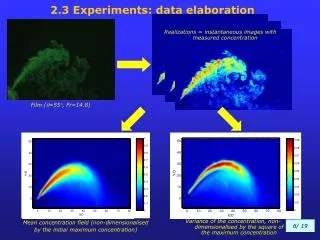
Realizations =instantaneous images with measured concentration Variance of the concentration, non-dimensionalised by the square of the maximum concentration Mean concentration field (non-dimensionalised by the initial maximum concentration) 2.3 Experiments: data elaboration Film (=55°, Fr=14.8) 6/ 19
Vortici oscillanti a valle di un cilindro investito da una corrente uniforme
Scia turbolenta a valle di un cilindro investito da una corrente uniforme Re=8000… … e Re=20000
Scia turbolenta in un’automobile … …e in una turbina
BOTTOM DENSITY CURRENTS • In case of free surface discharge, a stratified flow develops. • Anyway the discharge is done, brine sinks toward the bottom and brine travels downslope, following bottom bathymetry, as a stratified flow. • In a stratified flow, dilution is achieved with three mechanisms: molecular diffusion (very slow), dispersion by external forces (such as currents or tides, not always guaranteed) and turbulent mixing. • Kelvin-Helmholtz billows COURSE B – SECTION 10 – SLIDE 09
BOTTOM DENSITY CURRENTS • K-H billows develop when • In a stratified flow over the bottom of the sea, the thickness of layer mixed is • Mixing in negatively buoyant stratified flows happens if the velocity gradient is large (that is if the bottom is enough inclined) or nearto local bottom irregularities; after this mixing, there is another stratified flow, less dense, to be mixed. COURSE B – SECTION 10 – SLIDE 10